The Atwater Bungalows, Stacy-Judd’s Pueblo Revival pair in Echo Park
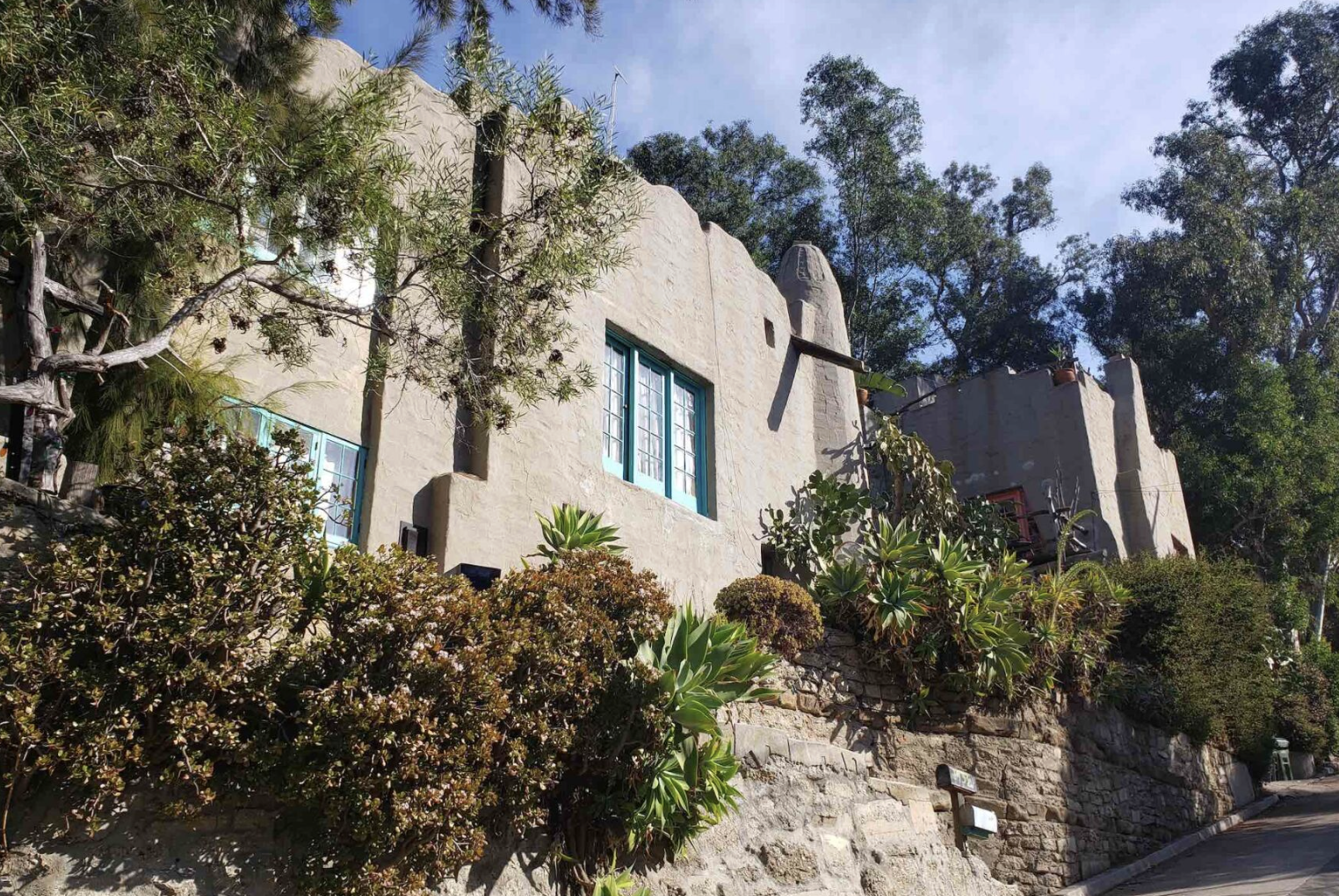
The Atwater Bungalows at a glance
Yes, you can remodel a Historic-Cultural Monument in Los Angeles. Designation protects the building, and sometimes the site, named in it. It does not freeze the house. Exterior work adds a review step through the city’s Office of Historic Resources, the property becomes eligible to apply for a Mills Act contract, and the designation transfers when you sell.
Echo Park · Field Notes
Robert Stacy-Judd’s 1931 Pueblo Revival pair on Avon Park Terrace, Los Angeles Historic-Cultural Monument No. 1241, and what the label means for an owner.
Two houses are set into the hillside at 1431 and 1433 West Avon Park Terrace, in the Elysian Heights pocket of Echo Park, with battered plaster walls that lean inward at the top, rounded corners, flat roofs drained by oversized wooden waterspouts, and balcony railings made of rough tree branches. They were built between 1930 and 1931. The architect was Robert Stacy-Judd. The Los Angeles City Council declared them a Historic-Cultural Monument on September 29, 2021, as Monument No. 1241, under case CHC-2020-7776-HCM. It is the clearest example an Echo Park realtor can give of what a monument designation does and does not cover.
What does a Los Angeles monument designation actually cover?
Here is the part that matters if you own something like this. The monument record for the Atwater Bungalows lists a range of addresses: 1401 to 1435 West Avon Park Terrace, 1406 West Cerro Gordo Street, and 2245 to 2247 North Park Drive. All of it sits on one parcel of roughly an acre and three quarters, holding a cluster of dwellings put up between 1908 and 1939 in a mix of styles. The designation application focused on the two Stacy-Judd bungalows. The address range describes the land they sit on.
That gap between the named structures and the named parcel is where most owners of designated California houses get surprised, and it is the first thing to settle in writing before anyone talks about price.
The architect who was hired for the wrong style
Stacy-Judd was born in London on June 21, 1884. He apprenticed with the architectural firm of James Thompson from 1900 to 1904, finished at the Kensington Science and Art Institute in London the following year, and in 1906 went to work as an architect for the Great Northern Railway. He crossed to the United States in the early 1910s, worked in North Dakota and Alberta, reached California in 1922, and was registered as an architect here in 1924.
What made his name was the Aztec Hotel in Monrovia, finished in 1925, which he promoted as the first commercial building in a Mayan Revival style he argued should become the American architecture of the twentieth century. He wrote books, lectured, and went to the Yucatan to photograph pyramids. His other commissions included the Philosophical Research Society headquarters in Los Feliz in 1934, the First Baptist Church of Ventura in 1932, and the North Hollywood Masonic Lodge in 1951. He died in Los Angeles in 1975. His papers are held at the UC Santa Barbara Architecture and Design Collection.
So here is the twist. The man who sold Los Angeles a Mayan fantasy was hired, by a dentist, to build something else entirely: a pair of Hopi-inspired Pueblo Revival houses, with kiva-style fireplaces inside.
The client was Dr. H. Gale Atwater, a Los Angeles dentist, and the “Atwater” in the name is his surname, not the neighborhood of Atwater Village across the river. He and his wife, Beulah, assembled the lots on Avon Park Terrace and merged them into one holding. The record is not perfectly consistent on when that started: the city’s designation report dates the acquisition and merger of adjacent lots to 1922, while a 2006 account built on family interviews puts the first purchases closer to 1910. Atwater had been drawn to Hopi architecture and philosophy, made trips to New Mexico, and had already designed two Hopi-style bungalows himself. He was not satisfied with how those came out, and Stacy-Judd got the next commission.
It did not end warmly. According to his grandson, the cost of the two bungalows and two garages ran far past the estimate of $7,800, and the family fell out with the architect while loving the houses. Construction finished in 1931, and the Atwaters struggled at first to find tenants who could carry the rent.
SurveyLA, the citywide historic resources survey, had already identified the property as individually eligible for national, state, and local listing as an excellent example of Pueblo Revival design.
Can you remodel a Historic-Cultural Monument in Los Angeles?
Yes, with review. If you own a Historic-Cultural Monument inside the City of Los Angeles, these are the practical consequences, and they are different from what owners usually assume.
- Review, not prohibition. Exterior alterations to a monument go through the city’s Office of Historic Resources, and work that affects the building’s character-defining features can be referred to the Cultural Heritage Commission. Your building permit still comes from the Department of Building and Safety. The review sits in front of it.
- Demolition and relocation are the hard stops. Those trigger Commission review and environmental review, and the commission can hold an action on a monument for a period set by the Cultural Heritage Ordinance. Interior work on items not named in the designation is usually a different conversation than the street-facing elevation.
- Jurisdiction decides everything. This parcel is in the City of Los Angeles, Council District 13, in the Silver Lake, Echo Park, and Elysian Valley community plan area. A similar house a few miles away in unincorporated Los Angeles County answers to the county’s landmark program and Regional Planning instead. Confirm which agency governs before you plan anything.
- Mills Act eligibility is not a Mills Act contract. Designation makes a property eligible to apply. A Mills Act contract is a separate ten-year renewing agreement, recorded against the property, under which the county assessor recalculates taxable value using an income approach. The city’s parcel record for this property at the time of designation showed no Mills Act contract. Eligibility by itself changes nothing on the tax bill, and a buyer who hears “Mills Act” and assumes a recorded contract is a buyer who will be unhappy later. The sale side of this is covered in selling a Mills Act or HCM home.
- Know what else is riding on the parcel. The city’s own report on this property noted a hillside designation, a Very High Fire Hazard Severity Zone, a special grading area, and rent stabilization applying to the parcel. Each of those has its own disclosure and its own effect on the buyer pool.
- Designation travels with the land. It is not a personal arrangement with the city, and it does not lapse when title changes hands.
Mills Act eligibility is not a Mills Act contract. Only a recorded contract changes the tax bill, so get it from the record, not from memory.
If you own a house like this and you are thinking about selling
Pull four things before you decide anything about price or timing.
- The designation resolution and the staff report. These are the documents that name what is protected. On this property that is case CHC-2020-7776-HCM. Read the description of features, because that paragraph is the real scope of the protection.
- The parcel record. Pull the assessor’s parcel number, the lot history, and any merger. If more than one dwelling sits on your parcel, your lender, your appraiser, and your buyer are all going to need that mapped out, and so will your disclosures.
- Any recorded Mills Act contract, or the absence of one. Get it from the record, not from memory.
- The permit history. Authorship claims live or die here. If you intend to market a house as the work of a named architect, you want the permit, the designation report, a survey finding, or an archive to back it, in that order of preference.
Then put the verified fact in the first line of the listing, not the adjective. “Historic-Cultural Monument No. 1241, designed by Robert Stacy-Judd, 1931” does more work than any sentence of praise. California buyers who shop architecture shop the architect and the record, and plenty of them are flying in from out of state to do it. For how the label shows up in the number itself, see how HCM designation affects home value.
Own a designated home?
For a real number grounded in the record and in current comps rather than an automated estimate, Debbie Pisaro will run a valuation. Request one here. Many of the homes she sells never reach the open market, so a quiet conversation is a fine place to start.
A designation is a document, not a mood.
On its street, and in California
Avon Park Terrace climbs the hill at the northwest edge of Elysian Park, and the houses it carries were built across three decades in different styles, which is normal for the hillside Eastside and abnormal for a tidy comp set. A couple of miles south, Angelino Heights holds the city’s oldest historic preservation overlay zone, covered in Angelino Heights and the Carroll Avenue HPOZ. Over the ridge, Silver Lake and Los Feliz hold one of the deepest concentrations of modernist and period revival housing in California, mapped in the Silver Lake architecture guide. Designated houses there read the same way on paper, from Edward Fickett’s Jacobson House, HCM #674 to the Seyler House, a 1920s Spanish Colonial Revival, and the full Los Feliz list is in the Los Feliz HCM guide. The same questions show up in the hillside pockets of Studio City, in Pasadena, and in Mar Vista; the Studio City architectural homes map shows how that kind of inventory gets mapped street by street.
Stacy-Judd’s own work spread the same way. Monrovia, Los Feliz, North Hollywood, and Ventura are not one market, and the buyer for a hand-troweled plaster house in Echo Park is often the same person who is watching an adobe in Ojai or a post-and-beam in Palm Springs. That is why a house like this calls for a Los Angeles historic and architectural real estate agent rather than a single zip code.
What the record does not show
The record does not show the total cost of construction, only that it overran the estimate. It does not show a recorded Mills Act contract on this parcel. It does not describe the current condition of either interior, and nothing here is a statement about any sale, any price, or any transaction on Avon Park Terrace. Debbie Pisaro does not represent these houses, and this post is not an offer to sell them. Where the city’s report and the family’s own account disagree on dates, both versions are above, and neither has been resolved.
What I think of the Atwater Bungalows
The detail I can't get past is the balcony railings. They're made of rough tree branches, on a pair of houses designed by the man who built the Aztec Hotel and argued that Mayan Revival should be America's architecture. A dentist hired him, and he built Pueblo instead.
What these houses do well is commit. Battered plaster walls that lean in at the top, rounded corners, flat roofs drained by big wooden waterspouts, kiva-style fireplaces inside. Nothing here is trying to be a little bit of everything. That's rare, and it's exactly what makes a house findable to the right buyer.
I picture someone who shops the architect, not the zip code. The person who has an adobe in Ojai saved on their phone, or a post-and-beam in Palm Springs, and who'd rather live with hand-troweled plaster than a tidy flip. Echo Park suits that person, and Elysian Heights suits them even more.
The honest part is the parcel. The monument record covers one large lot holding dwellings built from 1908 to 1939, plus a fire zone, a special grading area and rent stabilization. None of that is a reason to walk away. It's homework: before I'd talk price on anything like this, I'd pull the staff report, the parcel record and the permit history, and confirm there's no Mills Act contract on record.
Bottom line: I think the Atwater Bungalows are one of the most original things on the Eastside, and the kind of house where the record is half the value. Read what the designation names, and the rest of the conversation gets a lot easier.
Frequently asked
Can you remodel a Historic-Cultural Monument in Los Angeles?
Yes. Designation adds a review requirement; it does not freeze the house. Exterior changes go through the Office of Historic Resources, significant work can be referred to the Cultural Heritage Commission, and demolition or relocation faces the strongest review. You can still live in the house, maintain it, and sell it. You cannot quietly change the features the designation names.
Where are the Atwater Bungalows in Echo Park?
They are at 1431 and 1433 West Avon Park Terrace in Elysian Heights, Echo Park, Los Angeles 90026, at the northwest edge of Elysian Park. The monument record also lists 1401 to 1435 West Avon Park Terrace, 1406 West Cerro Gordo Street, and 2245 to 2247 North Park Drive, because the bungalows sit on one larger parcel.
Who designed the Atwater Bungalows?
Robert Stacy-Judd designed them in 1930 and 1931 for Dr. H. Gale Atwater, a Los Angeles dentist. Stacy-Judd was best known for the Mayan Revival Aztec Hotel in Monrovia, but for Atwater he built a pair of Hopi-inspired Pueblo Revival houses with battered plaster walls, wooden waterspouts, tree-branch railings and kiva-style fireplaces.
Are the Atwater Bungalows named after Atwater Village?
No. The name comes from the client, Dr. H. Gale Atwater, who with his wife, Beulah, assembled the lots on Avon Park Terrace and merged them into one holding. The houses are in Elysian Heights in Echo Park, across the Los Angeles River from Atwater Village, and the two are unrelated.
Does a Historic-Cultural Monument designation lower the value of a house?
Not by itself. In the architectural segment it often does the opposite, making the house findable and verifiable to the narrow group of buyers who want it. What moves a number is scope and comps: what the designation protects, what the parcel holds, and how thin the comparable sales are. That takes a real valuation, not an automated estimate.
What is the difference between Mills Act eligibility and a Mills Act contract?
Eligibility means a designated property may apply. A contract is the recorded ten-year renewing agreement that changes how the county assessor values the property, using an income approach, in exchange for maintenance and restoration obligations. Eligibility produces no tax change. Only a recorded contract does, and it transfers to the next owner.
What should I pull from the city before listing a designated Los Angeles home?
Pull the designation resolution and staff report, the parcel and assessor record including any lot merger, any recorded Mills Act contract, and the permit history. Then add the California disclosures that apply, including the Transfer Disclosure Statement, the Seller Property Questionnaire, the Natural Hazard Disclosure report, and any fire hazard zone disclosure.
How do I find an Echo Park real estate agent who knows historic homes?
Look for an agent who reads the designation report before the comps. Debbie Pisaro, founder of Coastline 840 and an Inman Luxury Leader, works on architectural and historic homes in Echo Park, Silver Lake and Northeast Los Angeles from her office at 160 Glendale Blvd. Many of the homes she sells never reach the open market.
Branded residences
From Beverly Hills to Malibu, Debbie tracks the Aman, Four Seasons and other branded projects across California. Tell her what you are looking for.
Buying or selling
Work with Debbie
A designation is a document. Read what it names, map it against the parcel, and you will know what you are selling or buying before anyone argues about price. As an Echo Park realtor with an office on Glendale Boulevard, Debbie reads the record first.
(310) 362-6429 · debbie@coastline840.com · 160 Glendale Blvd, Los Angeles, CA 90026
Reach DebbieDebbie Pisaro, California real estate agent, DRE #01369110. Coastline 840 is a DBA of Side, Inc., CA DRE #02014153, responsible broker.
Sources: Los Angeles Department of City Planning, Recommendation Report, CHC-2020-7776-HCM, Atwater Bungalows; Los Angeles City Clerk, Council File 21-0672; Los Angeles Department of City Planning, Historic-Cultural Monuments List; Echo Park Historical Society, reprint of Rebecca Kuzins, “Atwater Bungalows,” American Bungalow, Fall 2006; The Eastsider, coverage of the Atwater Bungalows monument nomination and designation; UC Santa Barbara Architecture and Design Collection, Robert Stacy-Judd papers.
Debbie Pisaro is a 24-year veteran, founder of Coastline 840, and an Inman Luxury Leader, representing buyers and sellers across Echo Park, Silver Lake and Northeast Los Angeles. She works on architectural, historic and design-forward homes across California. Many of the homes she sells never reach the open market. Read more about her work. Debbie Pisaro, California real estate agent, DRE #01369110. Coastline 840 is a DBA of Side, Inc., CA DRE #02014153.