
The short answer
If you want a mid century modern home realtor in Silver Lake, the Hawk House shows what to ask for. Harwell Hamilton Harris designed it for a hillside at 2421-2425 Silver Ridge Avenue in 1939, and it is Los Angeles Historic-Cultural Monument 1204. A house like this calls for an agent who reads the designation record before the listing photos.
Powered by Side: #1 California-based brokerage, No. 9 in the nation.
Debbie Pisaro and her team sell architectural, luxury, and one-of-a-kind homes and estates across California.
A 1939 Harris house on Silver Ridge Avenue that was also the home of a design company, and what its Monument status means for an owner.
A small house that doubled as a company headquarters
Harwell Hamilton Harris drew the Hawk House for Edwin “Stan” Stanton Hawk Jr. and Ethyle M. Hawk. The building permit is dated October 5, 1939, and lists a cost of $5,700. The result is a two story house of about 1,160 square feet on a steep hillside lot at 2421-2425 Silver Ridge Avenue, above the Silver Lake Reservoir.
The twist is what the Hawks did with it. According to the nomination the owner filed with the City, the Hawks ran a home accessories company called Hawk House from the address, established by 1948. It sold barbecue-braziers, lamps, and ashtrays. The brazier was designed by Roberto Coelho-Cordoza, a landscape architect from São Paulo, and it traveled well beyond the hillside. The nomination places it in Gregory Ain’s 1950 exhibition house at the Museum of Modern Art and on the cover of the Los Angeles Times Home magazine on October 21, 1951.
The Los Angeles County Museum of Art holds a cast iron barbecue-brazier, circa 1948, credited to R. Coelho-Cordoza and made by Hawk House of Los Angeles (accession M.2012.43). It was shown in the museum’s California Design, 1930 to 1965 exhibition. That gives the house a second claim: a Harris design that was also the address of a company whose product sits in a major museum.
Stay in touch
New Silver Lake house histories are added as they are written. Join the list to hear about the next one.
Join the Silver Lake listOr call Debbie directly: (310) 362-6429
Harwell Hamilton Harris, the Neutra apprentice with his own roofline
Harris was born in Redlands in 1903 and studied at the Otis Art Institute before going to work in Richard Neutra’s office in 1928. He opened his own practice in 1933. The Hawk House nomination lists the houses that made his name: the Pauline Lowe House in Altadena in 1934, his own Fellowship Park house, which won the 1936 House Beautiful Small House Competition, and the John Entenza house of 1937. The Lowe House was destroyed in the Eaton Fire in January 2025.
What marked Harris’s early houses was material and roofline: redwood and wood frame, hipped roofs, and wide eaves. The nomination cites the critic Esther McCoy on the Fellowship Park house, observing that all traces of the heavy masonry forms of the International style had faded. The Architectural Forum published the Hawk House in 1940 and 1941, a lot of attention for a house that cost less than six thousand dollars.
In 1952 Harris became director of the University of Texas School of Architecture, and he later taught at North Carolina State. He was named a Fellow of the American Institute of Architects in 1965 and died in 1990. Raphael Soriano, another of the Neutra-trained modernists, has his own page on Debbie Pisaro’s Raphael Soriano architect guide, and the master himself is on her Richard Neutra architect page. The rest of the Los Angeles modernists are gathered in her architects guide.
The house on its hillside
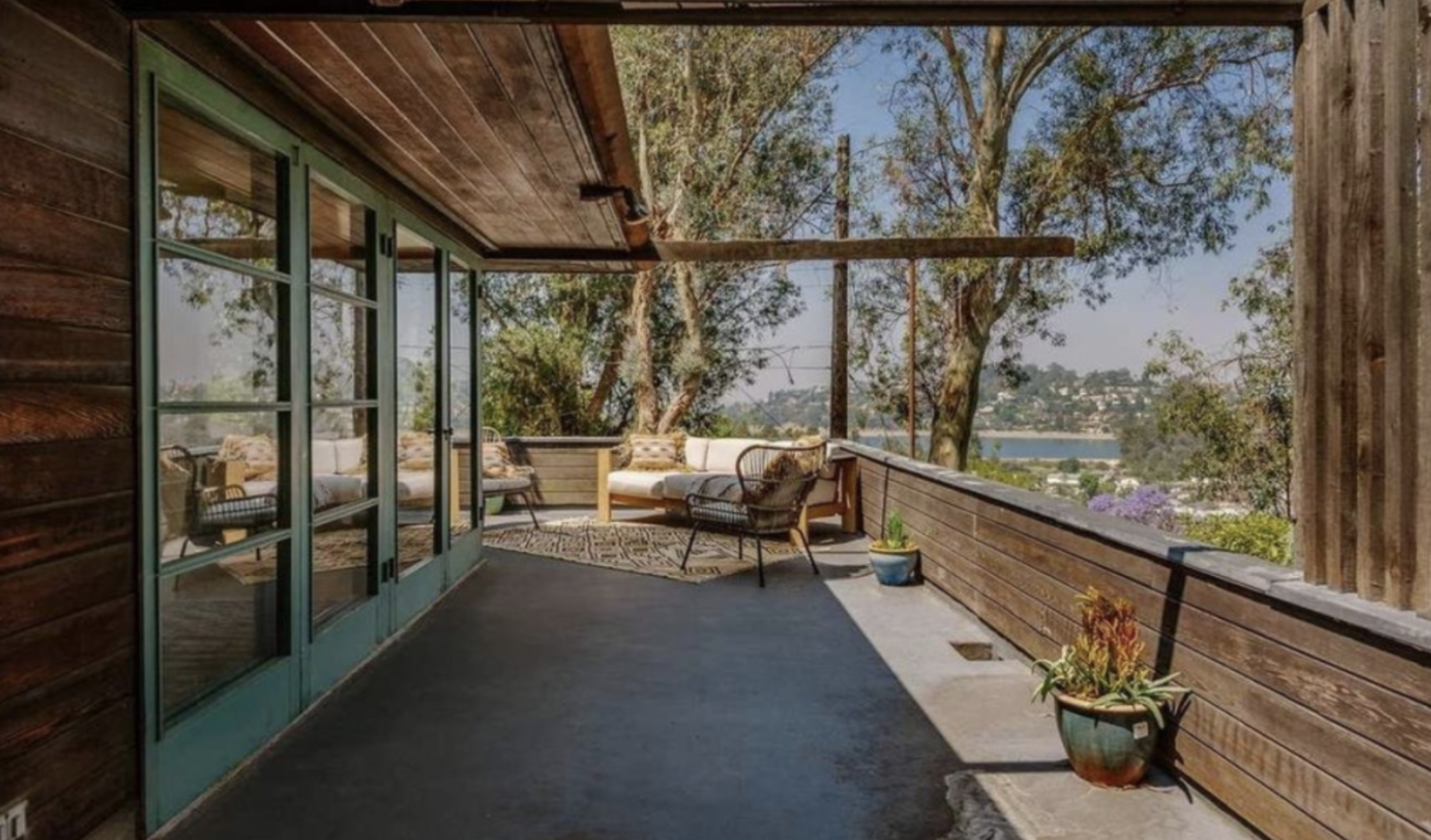
The Hawk House sits at a forty-five degree angle to the street and the property lines so that it runs parallel to the contour of the slope, a choice Harris explained as a way to simplify the floor levels. It is built of three intersecting rectangular volumes under a hipped roof with wide eaves, clad in redwood siding on a concrete foundation. A stair tower rises on the northeast side and a terrace wraps two elevations.
The nomination is specific about what to look for. The main entry is deeply inset and screened by vertical wood slats. The windows are wood casement and fixed sash. Inside, wood-framed sliding doors with textured panels replace swinging doors, picture rails and a cornice line that becomes a ledge run through the rooms, and the brick fireplace has no mantel. There are built-in bookshelves and bedroom bureaus with mirrors, a two-way cupboard between kitchen and dining room, and a kitchen fascia that works as a lightbox. These are the character-defining features a reviewer, an appraiser, or a buyer’s architect will ask about.
The record also shows what changed. In the 1960s, aluminum sliding doors replaced the wood multi-light doors in the first floor bedrooms and the entry screen was extended. A heating system went in around 1978. The nomination describes the house as little altered.
Harris turned the Hawk House forty-five degrees to the street so it could follow the hillside.
What the Hawk House label changes for an owner
Three different things get called landmark status in Los Angeles. Eligibility is a survey finding. Designation is a legal act. A recorded contract is a private agreement with the City. The Hawk House has the first two, and this post makes no claim about the third.
Eligibility came first. SurveyLA, the City’s historic resources survey, covered this area in a May 2014 report for the Office of Historic Resources and identified the Silver Ridge Avenue house as individually eligible as an Early Modern residence by Harris. That finding did not protect anything.
Designation came next. The nomination, case CHC-2019-4766-HCM, went before the Cultural Heritage Commission in September 2019, and the City’s Historic-Cultural Monument list records its adoption on February 4, 2020, under council file 19-1439, as Monument 1204. The Commission recommends and the City Council designates.
For an owner, the City’s own FAQ describes what that changes. Office of Historic Resources staff review and approve proposals for work before any alteration permit is issued, and the Cultural Heritage Commission reviews proposed exterior and interior alterations against the Secretary of the Interior’s Standards for Rehabilitation. The Commission can object to a demolition permit and delay demolition for up to 180 days, with a possible further 180 days if the City Council approves, and a Monument is presumed to be a significant resource under the California Environmental Quality Act. Designation does not guarantee a building can never be demolished. It buys time and review.
The Mills Act is a separate step. The City describes it as a revolving ten year contract between the City and the owner, renewed automatically each year, that transfers to the next owner on a sale. To enter one, a property must be a designated Monument or a contributor to a Historic Preservation Overlay Zone. A Monument is therefore eligible, but eligible is not enrolled. Whether any given house carries a recorded contract is a fact you confirm with the Office of Historic Resources and the county recorder, never from a listing. The Los Angeles Conservancy reports that the City stopped accepting new contracts in 2020 while the program is reassessed, so confirm the program’s status before you build a plan on it. Debbie Pisaro covers the mechanics on Los Feliz Living in selling a Mills Act home and how HCM designation relates to value.
Eligible is not enrolled. Whether a house carries a recorded Mills Act contract is confirmed with the Office of Historic Resources and the county recorder, never from a listing.
Silver Lake has no preservation overlay, and that cuts both ways
Los Angeles protects whole neighborhoods through Historic Preservation Overlay Zones, which put all exterior work under a preservation plan and a district board. The City’s list of adopted zones names Angelino Heights, Gregory Ain’s Mar Vista tract, Windsor Square, and many others. Silver Lake is not on it. Angelino Heights sits in the same community plan area, but it is not Silver Lake.
That absence has a concrete meaning for an owner. A Silver Lake house can be architecturally important, can even be named in a SurveyLA finding, and still have no design review standing between the owner and an exterior change, because eligibility is not designation. SurveyLA recorded a Silver Lake Residential Historic District of more than 1,000 properties, and no overlay has followed. The freedom is real. So is the exposure: an undesignated house can change in ways a designated one next door cannot, and it has no route to the Mills Act, since an overlay contributor is the only other path in. For a Silver Lake house, individual nomination is the only door, and the Hawk House is what walking through it looks like. Its nomination was filed by its owner. The City’s FAQ says any person or organization may submit a nomination and that the owner’s support is not required.
Off market
Many of the homes she sells never reach the open market. Ask Debbie Pisaro of Coastline 840 about private inventory across California, including architectural houses in Silver Lake.
Join the Pocket Listings listIf you own a house like this
Debbie Pisaro is not the listing agent for the Hawk House. This section is for the owner of a Silver Lake house with a pedigree who is thinking about selling.
Before anything is photographed, pull four records. First, the designation file if there is one: the Monument number, the case number, and the City’s recommendation report with its list of character-defining features. Second, the SurveyLA evaluation, which exists even for houses that were never designated and is the quickest way to show a buyer’s architect that someone qualified has already looked. Third, the permit history, matched against the features list, so that you know which original details were replaced and when. Fourth, any recorded Mills Act contract, with its date and terms, or a clear statement that none exists.
Then put the proof in the first line of the listing, ahead of the bedroom count. The architect, the year, and the Monument number do more for a buyer who searches by architect than any adjective. Have written down what review applies to a buyer’s first remodel. The quieter side of this work is covered in how pocket listings work, and a valuation that starts from the designation record rather than a portal estimate begins at Coastline 840’s home valuation page. For how Debbie Pisaro works with houses like this across California, see her page as an architectural homes specialist.
Put the architect, the year, and the Monument number in the first line of the listing.
Silver Ridge Avenue and the wider California story
The Hawk House shares its block with some of the most written-about early modern houses in Los Angeles. Directly across the street at 2422 North Silver Ridge Avenue is R. M. Schindler’s How House of 1925, Monument 895, designated on November 20, 2007, which Debbie Pisaro profiles on her How House page. It also sits at a forty-five degree angle to the street. Schindler’s wider work is on her R. M. Schindler architect page. At 2351 Silver Ridge Avenue, the Sabsay House, by J. R. Davidson with later Schindler additions, is Monument 1166, designated June 26, 2018, and the nomination places Gregory Ain’s Scharlin Residence of 1937 at 2363; Ain has his own Gregory Ain architect page. The Silver Lake and Ivanhoe Reservoirs, designed by William Mulholland and built in 1906 and 1907, are Monument 422.
Harris’s other Silver Lake work includes the Joel house on Silverwood Terrace, which the nomination cites as a nearby hillside comparison, and the Alexander House of 1941, which SurveyLA lists beside Soriano’s Lipetz House of 1935, Monument 967. Debbie Pisaro’s Silver Lake architecture guide covers the Moreno Highlands, the Neutra Colony, and the houses that cluster around the reservoir, and two of the neighborhood’s later landmarks have pages of their own: John Lautner’s Silvertop and William Kesling’s Skinner House.
SurveyLA calls the Silver Lake, Echo Park, and Elysian Valley area one of the most important concentrations of Early Modern, International Style, and Mid-Century Modern residences in Los Angeles, and the Hawk House nomination describes Silver Lake as a hotbed of pre-war Early Modernism. Debbie Pisaro places that in a California frame: Silver Lake is one of the deepest concentrations of modernist housing in California, and the same architects worked well beyond it. Harris’s Havens House in Berkeley is on the National Register of Historic Places, and his Wylie House in Ojai dates to 1948. Debbie’s architectural work across the state starts at debbiepisaro.com.
The record also leaves several things open, and this post does not fill them in. It does not say whether the Hawk House carries a recorded Mills Act contract, and it makes no claim that it does. The nomination’s summary lists a 2019 bathroom addition and a basement conversion, while its written statement says there were no permitted alterations, so the two parts of one document disagree. The nomination does not name a contractor. Sources spell the brazier designer’s surname three ways, Coelho-Cordoza, Coelho-Cardozo, and Cordoza, and this post uses the Los Angeles County Museum of Art’s spelling. The nomination dates the Hawks’ company to 1948 or earlier and gives no earlier date.
Sources: City of Los Angeles Department of City Planning, Hawk House recommendation report, CHC-2019-4766-HCM; City Planning, Historic-Cultural Monuments list; City Planning, Historic-Cultural Monument Process FAQs; City Planning, Local Historic Districts (HPOZs); City Planning, Mills Act Historical Property Contract Program; SurveyLA, Historic Resources Survey Report, Silver Lake, Echo Park, and Elysian Valley; Los Angeles Conservancy, City of Los Angeles Mills Act Program; Los Angeles County Museum of Art, Barbecue-brazier, M.2012.43.
How I read the Hawk House
What struck me right away: how much of this house is about light, even on paper. A kitchen fascia that works as a lightbox. Sliding doors with textured panels instead of solid ones. Wide eaves on a hillside above the reservoir. Harris was managing light on a $5,700 budget, and the City’s record lists every one of those choices.
It doesn’t fight the hill. Turning the whole house forty-five degrees to the street sounds like a gesture, but it’s practical: the floor levels get simpler and the house sits with the slope instead of on top of it. At about 1,160 square feet, every built-in is doing real work, from the bookshelves to the bureaus with mirrors to that two-way cupboard between the kitchen and the dining room.
I picture someone who’d rather live in a room than look at one. A designer, a writer, a couple who cook. Somebody who learns the Hawks ran a company out of this address and finds that more charming than odd.
What gives me pause is the paperwork, not the house. The nomination disagrees with itself about the 2019 bathroom and basement work, and nothing I’ve read says whether there’s a Mills Act contract. For a buyer, those are my first two calls, the Office of Historic Resources and the county recorder, before anyone falls in love.
Bottom line: this is a Silver Lake house that rewards a buyer who reads. Small, careful, and well documented, it will mean more to the right person than its square footage suggests.
Frequently asked questions
Where is the Hawk House?
The Hawk House is at 2421-2425 Silver Ridge Avenue in Silver Lake, Los Angeles, above the Silver Lake Reservoir. It stands across the street from R. M. Schindler’s How House at 2422 North Silver Ridge Avenue. It is a private residence, so it is best understood from the City’s designation record rather than from the sidewalk.
Who designed the Hawk House?
Harwell Hamilton Harris designed the Hawk House for Edwin and Ethyle Hawk. The building permit is dated October 5, 1939. It is a two story redwood-clad house of about 1,160 square feet, turned forty-five degrees to the street to follow the hillside, and Harris trained in Richard Neutra’s office before opening his own practice in 1933.
Is the Hawk House a landmark?
Yes. The City of Los Angeles lists the Hawk House as Historic-Cultural Monument 1204, case CHC-2019-4766-HCM, council file 19-1439, adopted on February 4, 2020. The Cultural Heritage Commission recommends designations and the City Council adopts them. SurveyLA had earlier found the house individually eligible, which was a survey finding, not a designation.
Can you remodel a Historic-Cultural Monument in Los Angeles?
Yes, with review. City Planning’s Office of Historic Resources staff review and approve proposed work before alteration permits issue, and the Cultural Heritage Commission reviews exterior and interior changes against the Secretary of the Interior’s Standards for Rehabilitation. Demolition can be delayed up to 180 days, plus a possible 180 more with Council approval.
Does Silver Lake have an HPOZ?
No. The City’s list of adopted Historic Preservation Overlay Zones does not include Silver Lake. Angelino Heights has one, but it sits in Angelino Heights. SurveyLA recorded a Silver Lake historic district as eligible, and eligibility is not designation, so only individually designated houses carry design review.
How do you get a Mills Act contract for a Silver Lake house?
A property must be a designated Historic-Cultural Monument or a contributor to an overlay zone, and Silver Lake has no overlay, so individual designation is the only route. The Los Angeles Conservancy reports the City stopped accepting new contracts in 2020. Confirm program status with the Office of Historic Resources before planning around it.
Is a house like the Hawk House mid century modern?
No. At 1939 it is Early Modern, built before the war, and SurveyLA files it under Early Modernism. Silver Lake holds Early Modern, International Style, and mid century houses side by side, which is why the best choice of a Silver Lake realtor is one who can tell them apart and cite each house’s record.
What should a realtor pull before listing a designated Silver Lake house?
Pull the designation file with its list of character-defining features, the SurveyLA evaluation, the permit history, and any recorded Mills Act contract. Put the architect, the year, and the Monument number in the first line of the listing. Debbie Pisaro can walk you through each record before a photographer arrives.
Buying or selling
Work with Debbie
Debbie Pisaro of Coastline 840 represents buyers on architectural and historic homes across California, regardless of who holds a given listing. If you own a Silver Lake house with an architect’s name on it, she is glad to talk it through.
(310) 362-6429 · debbie@coastline840.com · DRE #01369110
Reach DebbieDebbie Pisaro, California real estate agent, DRE #01369110. Coastline 840 is a brand/DBA of Side, Inc., CA DRE #02014153, responsible broker.
By Debbie Pisaro, a 24-year veteran, the founder of Coastline 840, and an Inman Luxury Leader · California real estate agent, DRE #01369110 · Debbie Pisaro is not the listing agent for the Hawk House · About Debbie