
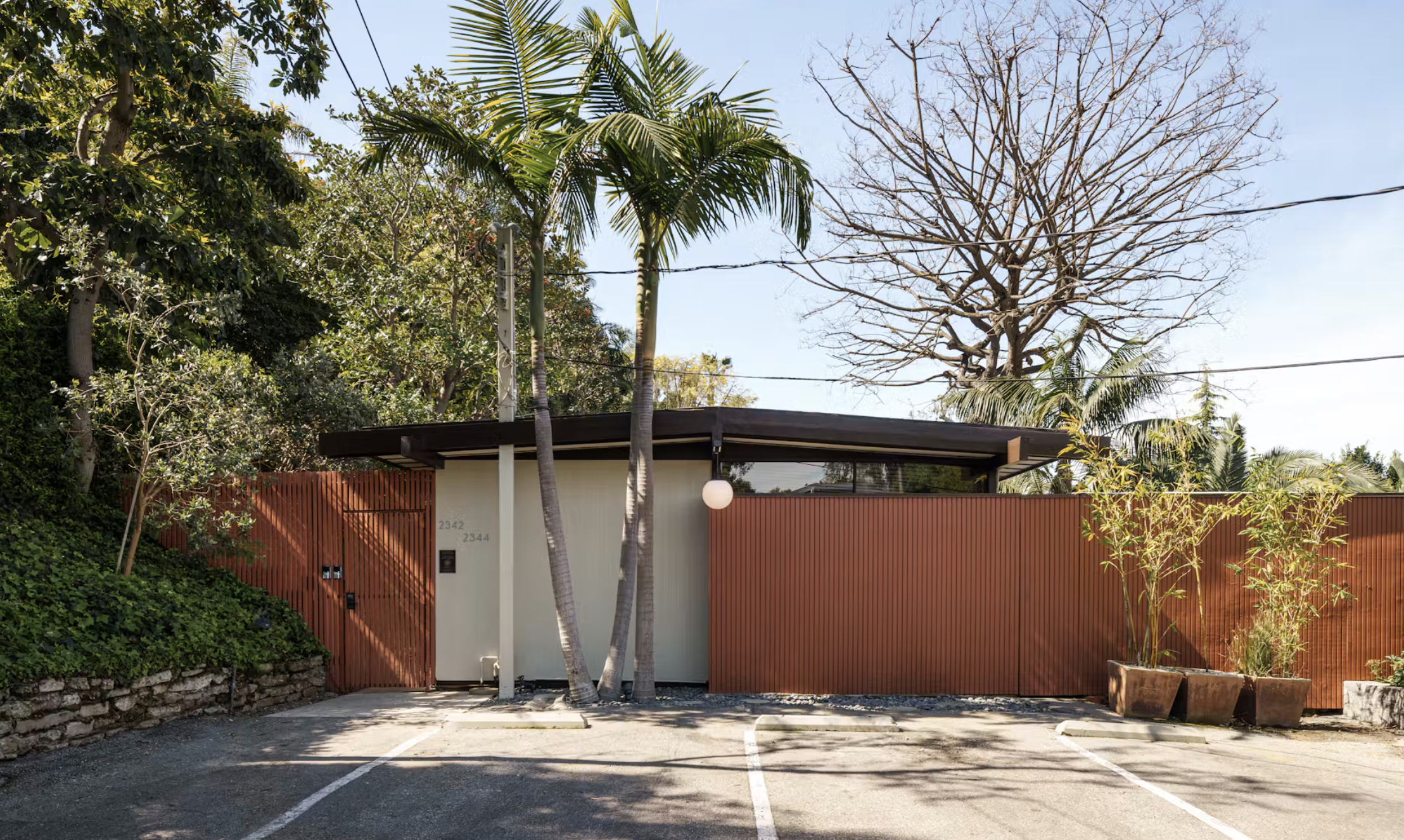
The O'Neill Duplex at a glance
The O'Neill Duplex No. 1 at 2342 Cove Avenue in Silver Lake is Los Angeles Historic-Cultural Monument No. 868, built in 1953 by the designer and builder Rodney Walker and declared on May 16, 2007. Its matching twin next door was remodeled in 2005 and carries no designation, and the gap between the two shows what designation changes.
Silver Lake · Field Notes
Rodney Walker built two matching duplexes on one Silver Lake slope in 1953. One is a monument. The other was remodeled, and nothing in the rules stood in the way.
Ask a mid century modern home realtor Silver Lake sellers trust where the story of a house starts, and the answer should be the record. For the O'Neill Duplex No. 1, the record is short and exact. Los Angeles declared it Historic-Cultural Monument No. 868 on May 16, 2007. Rodney Walker designed and built it in 1953 for Virginia O'Neill, and Julius Shulman photographed it a year later. Any Silver Lake realtor who sells architectural houses here should know this one, because its twin explains the rules better than any guide.
What is the O'Neill Duplex in Silver Lake?
The O'Neill Duplex is a 1953 rental building by Rodney Walker on Cove Avenue, one of two matching duplexes he built for the same client on adjoining graded lots above the Silver Lake Reservoir. It is a duplex, and that matters. Virginia O'Neill wanted income property, and Walker gave her a pair of buildings rather than one trophy house.
He brought a Case Study sensibility to a rental. That is rarer in Los Angeles than it sounds. Most of the city's celebrated mid-century houses were built for one family with money to spend; Walker spent his attention on a building meant to be lived in by tenants, and he made it worth photographing. Shulman's 1954 pictures caught both buildings when they were new and still alike.
The pair stayed under one owner until 2004. After that, the paths split. In 2005 the second duplex was remodeled into a single-family house. The first kept its original character, and only the first was put forward for designation. The wider neighborhood story, from the reservoir to the modernist hills, is in Debbie Pisaro's Silver Lake architecture guide.
Silver Lake Watch
The streets, the houses, and what is actually selling in Silver Lake, from Debbie Pisaro. The fastest way in is a call.
Call (310) 362-6429Who was Rodney Walker, the builder who designed it?
Rodney Walker was a Los Angeles designer and builder, born in Salt Lake City in 1910 and raised in Ely, Nevada, who designed and built somewhere between seventy-five and a hundred houses and three Case Study Houses without ever holding an architect's license. He studied at Pasadena City College and UCLA, and in the late 1930s he worked briefly as a draftsman for R.M. Schindler.
That short stint is the direct line between Walker and the architect whose How House stands on Silver Ridge Avenue, a short walk from Cove Avenue. Schindler's wider body of work is collected on the R.M. Schindler architect page.
The house count is a range because no complete list survives; his son Craig gives seventy-five to a hundred. Three went into the Case Study House program. Case Study House 16, finished in 1946, was his own home in Beverly Hills. Number 17 went up in the Hollywood Hills and number 18 in Pacific Palisades. A 1948 showing of his work at a UCLA gallery made his name, and he kept working alongside his own crew and keeping his costs down, which was the program's original brief.
Here is the part that makes him worth a second look. Walker never formally studied architecture and was never licensed. He thought of himself as a builder first. He later left design behind for the Ojai Valley, where he ran the Oaks hotel for about fifteen years, made and sold jewelry, and died at home on June 18, 1986. His steel and glass hilltop house on Rancho Drive, his home from the late 1950s, was the one he counted as his best. That chapter is told in the Rodney Walker houses in Ojai, and his Valley work in the Rodney Walker houses on Alta Mesa Drive.
One caution for any conversation about a Walker. The program reused his numbers: Craig Ellwood later built Case Study Houses 16, 17 and 18, so the archives list Walker's second and third as 17A and 18A. If a seller or a shopper calls a house "Case Study House 18," ask which one.
My take on the O'Neill Duplex No. 1
What struck me, reading the record, was the light in Julius Shulman's 1954 photographs. He shot both duplexes when they were brand new and still alike, two buildings catching the same Silver Lake sun on the same slope. Decades later, only one of them would still match his pictures.
That's what this house does well: it stayed itself. Rodney Walker gave a rental building the care most designers saved for a client's own home, and Duplex No. 1 held on to it through decades of owners and tenants. A building that was never meant to be precious turned out to be the one worth protecting.
I picture someone who wants to live inside a piece of Los Angeles history without living in a museum. Maybe an owner who takes one unit and rents the other, the way Virginia O'Neill meant it to work. Maybe a buyer who has read about Case Study houses for years and would rather own the honest, working version.
The honest part is the paperwork. A monument comes with review, and the Mills Act route depends on the city taking applications again. Before anyone falls for this house, I'd pull the designation file, confirm what the city counts as character-defining, and find out where the Mills Act window stands. That's homework I do before the first showing, not after the offer.
Bottom line: it's the rare house where the record and the building still agree, and in Silver Lake that's worth more than square footage.
Why is only one of the two O'Neill duplexes a monument?
Only Duplex No. 1 is a monument because only Duplex No. 1 kept the character Walker gave it in 1953. Same designer, same client, same year, same hillside, two buildings drawn as a pair. Stand on Cove Avenue and you are looking at the clearest before and after in Silver Lake.
Blaming an owner misses the point. The question worth asking is what stood between that owner and a remodel. In Silver Lake, the answer was nothing.
Two duplexes, one designer, one year. Only one is still the building Walker drew.
Does Silver Lake have an HPOZ historic district?
Silver Lake has no Historic Preservation Overlay Zone. Los Angeles has about three dozen HPOZs, its local historic districts, and Angelino Heights, adopted in 1983 as the city's first, sits next door in Echo Park rather than in Silver Lake. A new district would change this answer, so check the current list on City Planning's local historic districts page before relying on it.
Two consequences follow, and they cut in opposite directions.
First, a significant Silver Lake house that is not individually designated has no preservation design review between its owner and an exterior change. No district board, no contributor status, no conformance finding. That is how the second O'Neill duplex could become a different building in 2005 on ordinary building permits. For an owner who wants a free hand, that is an advantage, and it deserves to be said plainly.
Second, there is no HPOZ route into the Mills Act here. A Los Angeles property qualifies for a Mills Act historical property contract only as an individually designated Historic-Cultural Monument or as a contributor in an HPOZ, and the city sets property value limits on top of that. With no HPOZ in Silver Lake, individual designation is the only door, which makes the nomination process worth understanding.
How does a Silver Lake owner get a Mills Act contract?
A Silver Lake owner gets a Mills Act contract only through individual designation as a Historic-Cultural Monument, and only when the city is taking applications. Los Angeles stopped accepting new applications in 2020 while it reassessed the program, so the first call is to the Office of Historic Resources to ask whether the window has reopened. Contracts already recorded stay in force, renew each year, and pass to the next owner with the property.
Eligibility and a recorded contract are two different things. A buyer paying a premium for the first should confirm whether the second can actually be had. What designation always gives a Silver Lake house is review: the city's Office of Historic Resources looks at proposed alterations to a monument before permits issue. Without designation, the house has freedom and no Mills Act route; with it, the house has review and the only door into the Mills Act.
The mechanics of selling a house that already carries a contract are in selling a Mills Act or Historic-Cultural Monument home, and the value question is worked through in what designation does to home value.
Before it is public
Designated and architect-designed houses on this side of the reservoir often trade quietly. Debbie Pisaro keeps a private list of off-market and pre-market homes.
See off-market homesWhat should you pull before selling a designated Silver Lake house?
Before listing a designated Silver Lake house, pull four things: the designation file, the SurveyLA evaluation if there is no designation, any recorded Mills Act contract, and the archive attribution for the architect. A documented Walker, Kesling, Soriano or Schindler on a Silver Lake slope prices against its own record, and the record is work you can finish before a sign goes up.
Start with the designation file if the house is a monument. The nomination names the character-defining features the city meant to protect, and that list is the most useful page in the folder. It tells a buyer what cannot casually change, and it tells you which of your own improvements will read as sympathetic.
Pull the SurveyLA evaluation if the house was never designated. An eligibility finding is not a designation and should never be sold as one, but it is a city document that names your architect and your style, and that is worth more in a listing than an adjective.
Pull the recorded Mills Act contract if one exists, and say plainly whether it exists. "Mills Act eligible" and "Mills Act contract recorded" are different claims with different values, and conflating them is the mistake that gets caught in escrow.
Then pull the archive attribution. A catalogue entry, a survey line, a permit or a Shulman negative beats a listing adjective every time. Put the proof in the first line of the listing: the architect's name, the year, and the monument number if there is one. That is what an architectural buyer searches for, and it is the discipline Debbie Pisaro brings as an architectural homes specialist.
Debbie Pisaro is a 24-year veteran, founder of Coastline 840, and an Inman Luxury Leader, representing buyers and sellers across Silver Lake, Echo Park and the surrounding neighborhoods. Many of the homes she sells never reach the open market.
Designation brings review, not a freeze. Without it, a Silver Lake house has freedom and no Mills Act route; with it, the house has review and the only door into the Mills Act.
What is near the O'Neill Duplex on Cove Avenue?
Cove Avenue climbs above the reservoir, and the Mattachine Steps are part of it: the public stairway on Cove Avenue carries the name of the Mattachine Society, the early gay rights group founded in 1950 by Harry Hay, who lived on Cove Avenue. Walk out from the duplex and the neighborhood's argument with itself is all within reach.
Schindler's How House on Silver Ridge Avenue, finished in 1925, steps down its slope in concrete and redwood, built by the man Walker would later draft for. Richard Neutra's houses gather on Neutra Place and the Neutra Colony. John Lautner's Silvertop is the neighborhood's loudest building and a useful opposite to a rental duplex. William Kesling's Skinner House on Easterly Terrace is another designer-builder's work the neighborhood kept. For the area itself, start with Explore Silver Lake.
Walker's trail runs out of these hills and across Southern California: Beverly Hills, the Hollywood Hills, Pacific Palisades, Studio City and finally the Ojai Valley. Debbie Pisaro works the same geography, from the Eastside to Ojai and the coast, and the Silver Lake realtor question is the same everywhere along it: what does the record say, and who has read it.
Debbie Pisaro is not the listing agent for 2342 Cove Avenue. Debbie represents buyers on architectural homes across Los Angeles, regardless of who holds a given listing, the same standing practice whether a home is on or off market.
The O'Neill Duplex and Silver Lake designation, answered
Who is a good mid century modern home realtor Silver Lake homeowners can call?
Debbie Pisaro of Coastline 840 works with buyers and sellers of architect-designed and Historic-Cultural Monument houses in Silver Lake, Echo Park and across California, and she prices them from the record rather than from square footage alone. She is an Inman Luxury Leader, DRE #01369110, reachable at (310) 362-6429.
Where is the O'Neill Duplex?
The O'Neill Duplex No. 1 stands at 2342 Cove Avenue, Los Angeles, CA 90039, in Silver Lake above the reservoir. Its matching twin, the second duplex Rodney Walker built for Virginia O'Neill in 1953, stands beside it on the same slope. Both are private residences, so the pair is best seen from the public street.
Who designed the O'Neill Duplex?
Rodney Walker designed and built the O'Neill Duplex in 1953 for Virginia O'Neill, and Julius Shulman photographed it in 1954. Walker contributed three houses to the Case Study House program, yet he never held an architect's license and thought of himself as a builder. Los Angeles declared the duplex Historic-Cultural Monument No. 868 in 2007.
Is there an HPOZ historic district covering Silver Lake in Los Angeles?
No. Los Angeles has about three dozen Historic Preservation Overlay Zones, and none covers Silver Lake. Angelino Heights, the city's first in 1983, sits next door in Echo Park. A significant Silver Lake house without individual designation therefore has no preservation design review. A new district would change that, so check City Planning's district list before relying on it.
How does a Silver Lake owner get a Mills Act contract?
Only through individual designation. Mills Act eligibility in Los Angeles needs Historic-Cultural Monument status or HPOZ contributor status, and Silver Lake has no HPOZ. The city stopped taking new applications in 2020 while it reassessed the program, so ask the Office of Historic Resources whether the window has reopened. Recorded contracts pass to the next owner.
Can you remodel a Historic-Cultural Monument?
Yes, with review. Designation does not freeze a house; it puts proposed alterations in front of the city's Office of Historic Resources before permits issue, and the designation file names the features the city means to protect. An undesignated Silver Lake house has no such review at all, which is how the second O'Neill duplex became a different building.
What should a seller pull before listing a designated Silver Lake house?
Four documents. The designation file, which names the character-defining features. The SurveyLA evaluation, if the house was surveyed but never designated. Any recorded Mills Act contract, stated as recorded rather than merely eligible. And the archive attribution for the architect. Then put the architect, the year and the monument number in the first line of the listing.
Why is only one duplex a monument?
Only Duplex No. 1 kept its 1953 character. The two buildings shared a designer, a client, a year and a hillside, and they stayed under one owner until 2004. In 2005 the second was remodeled into a single-family house, so when the nomination went forward, only the first still read as the building Rodney Walker drew.
Buying or selling in Silver Lake
Work with Debbie Pisaro
Debbie Pisaro of Coastline 840, Silver Lake, works with buyers and sellers of architect-designed and Historic-Cultural Monument houses across the Eastside and California, and she brings the record with her. Many of the homes she sells never reach the open market.
Debbie Pisaro · (310) 362-6429 · debbie@coastline840.com
DRE #01369110 · 160 Glendale Blvd, Los Angeles, CA 90026
Debbie Pisaro, California real estate agent, DRE #01369110. Coastline 840 is a DBA of Side, Inc., CA DRE #02014153, responsible broker.
Debbie Pisaro of Coastline 840, a boutique California practice · California real estate agent, DRE #01369110 · Inman Luxury Leader. Debbie brings 24 years of experience to architectural and historic homes across Silver Lake, Echo Park, Northeast Los Angeles and California. Many of the homes she sells never reach the open market. Coastline 840 is a DBA of Side, Inc., CA DRE #02014153, responsible broker. About Debbie · debbiepisaro.com
On the Register
On the Register is the record we keep of California architecture: its architects, streets, styles, and design-forward homes. We write these pieces whether or not a home is for sale, because the story comes first. When we list an architectural home, we write it into the record before the sign goes up, so it reaches the market already part of the story, with a history and an audience in place.
© 2026 Debbie Pisaro, Coastline 840 · ontheregister.com