
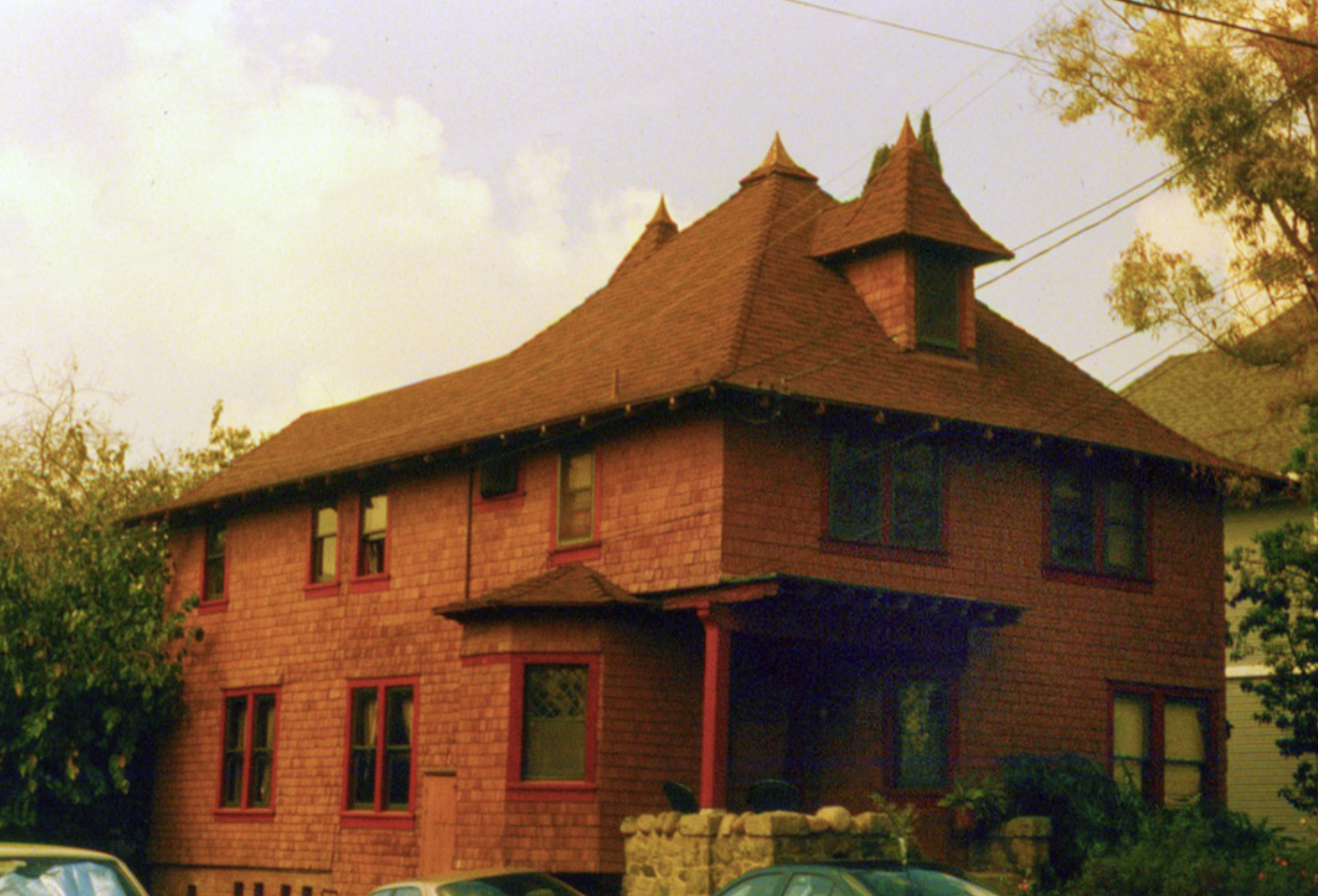
The Benton Residence at a glance
Architectural homes Echo Park for sale fall on two sides of one line. Angelino Heights sits inside the first Historic Preservation Overlay Zone in Los Angeles, where design review is real, and the Arthur B. Benton Residence, Historic-Cultural Monument #827 at 801 East Kensington Road, stands on that protected side.
Angelino Heights · Field Notes
Arthur B. Benton drew the Mission Inn in Riverside, helped save the California missions, and then bought a Kensington Road spec house from his own client and stayed thirty-one years.
Two streets in Angelino Heights get photographed. Carroll Avenue, whose 1300 block has been on the National Register of Historic Places since 1976, and Kellam Avenue just up the hill. Kensington Road is the one almost nobody writes about, and it holds the house the architect of the Mission Inn designed, sold, bought back and died in. For an Echo Park realtor, it is also the clearest lesson in how the rules work on this side of the lake.
What is the Arthur B. Benton Residence in Angelino Heights?
The Arthur B. Benton Residence is an 1896 Shingle Style house at 801 East Kensington Road, built as a speculative house by the firm of Aiken and Benton and bought that same year by Arthur B. Benton himself. Los Angeles declared it Historic-Cultural Monument #827 on November 2, 2005.
If you are looking at architectural homes in Echo Park, this is the house to understand first, because its paperwork is the paperwork every serious Angelino Heights purchase runs into. It is an individually designated monument. It sits inside a historic district with a working review board. And it is a short walk from Echo Park blocks that have neither.
Echo Park Watch
The streets, the houses, and what is actually selling in Echo Park, from Debbie Pisaro. The fastest way in is a call.
Call (310) 362-6429Who was the house actually built for?
Benton built the house for Mary Stilson, and she was not a client in the ordinary sense. She was the widow of William W. Stilson, who filed the subdivision of the Angelino Heights tract with Everett E. Hall on March 19, 1886; Carroll Avenue takes its name from their son, Carroll Stilson. After her husband died, Mary Stilson kept the family's development business going, and she commissioned speculative houses from Aiken and Benton as the principal.
Benton designed this one in 1896 as one of those spec houses. Later the same year he bought it from her. Then he spent three decades turning a builder's product into an architect's own house: he enlarged the dining room in 1903, redesigned the interior in 1912, put up a concrete garage behind the house in 1913, and in 1926 built a Japanese tea house on the garage roof, level with the rear yard. He died at home in 1927, thirty-one years after he moved in.
A spec house is the thing an architect walks away from. Benton bought this one and stayed.
The record shows a woman running a development operation in 1890s Los Angeles whose product was good enough that her own architect became her customer. It also shows that the line between builder-built and architect-designed, which buyers and appraisers lean on heavily in Angelino Heights, was never as clean as a listing makes it sound.
Benton was not finished with Mary Stilson either. In 1906 he designed her own house, a Craftsman that Los Angeles declared Historic-Cultural Monument #824 in November 2005, the same month as his. It was cut into four units in the 1930s. Benton also designed a house next door for her son Fielding. One road, one architect, one client, and a cluster of monuments to show for it.
Why the Arthur B. Benton Residence stays with me
What struck me, and stayed with me, is the shingle. Arthur Benton gave California its best-known Mission Revival hotel, and then went home every night to a shingled house on Kensington Road. The material tells you who he was when nobody was paying him to make a statement.
What the house does well is hold thirty-one years of one architect's attention. He bought a spec house and kept working on it: a bigger dining room in 1903, a new interior in 1912, a concrete garage in 1913, and a Japanese tea house on the garage roof in 1926. You can read a whole life in that list.
I picture a buyer who loves that kind of layering, someone who wants a house with a story they can keep adding to, on a street where the district makes sure the neighbors keep their character too. Angelino Heights rewards people who like rules that protect what they love.
The honest part is the review. This house carries its own monument number and sits inside the HPOZ, so any exterior change goes through the board and the Preservation Plan. Before anyone plans a project, I'd confirm the parcel's status with City Planning, pull the designation record, and price the house with that review built in. That's my homework, so it never becomes a buyer's surprise.
Bottom line: a spec house its own architect couldn't walk away from is about the best recommendation a house can get.
Who was Arthur B. Benton, the architect of the Mission Inn?
Arthur Burnett Benton was a Los Angeles architect, born in Peoria, Illinois, on April 17, 1858, and one of the leading promoters of Mission Revival architecture in early twentieth-century California. He studied at the School of Art and Design in Topeka, Kansas, drafted for the Atchison, Topeka and Santa Fe railroad, and came to Los Angeles in 1891. In 1893 he went into partnership with William Cleveland Aiken. He was a founding member of the Southern California Chapter of the American Institute of Architects and served as its president several times. He died on September 18, 1927.
His best-known building is the original Mission Inn in Riverside. Frank Augustus Miller saw Benton's First Church of Christ, Scientist in Riverside, commissioned in 1900, and hired him for the hotel; work on the first phase began in 1902. Benton came back for the Cloister Wing, which opened in 1911. He designed the second Arlington Hotel in Santa Barbara after the first burned in 1909, a building the 1925 earthquake damaged so badly that it was torn down. He designed the Mission Playhouse in San Gabriel, which opened in 1927, the Mary Andrews Clark Memorial Home at Third Street and Loma Drive in Los Angeles, and the San Marcos Hotel in Chandler, Arizona.
He also helped save the real thing. Benton helped Charles Fletcher Lummis and the architect Sumner P. Hunt found the Landmarks Club in the 1890s, and as its secretary he oversaw restoration work at Mission San Juan Capistrano and Mission San Diego de Alcala. His work is included in Robert Winter's anthology of the Arts and Crafts architects of California, which is the key to Kensington Road: the man who gave California its best-known Mission Revival hotel built here in a quieter, shingled domestic idiom.
One point of confusion is worth clearing up, because it shapes what you find when you search. Arthur B. Benton has nothing to do with Benton and Park, the mid-century firm of D. Wallace Benton and Donald G. Park. Both appear in the register of California architects Debbie Pisaro maintains, and they are two unrelated bodies of work two generations apart.
Does Echo Park have an HPOZ historic district?
Echo Park has one Historic Preservation Overlay Zone, Angelino Heights, which the City Council adopted in 1983 as the first HPOZ in Los Angeles and expanded by a second ordinance in 2008. The rest of Echo Park has no HPOZ, so for any given house the district boundary decides which rules apply. A new district would change that, so check City Planning's local historic districts list.
Inside the boundary, the district runs on a Preservation Plan dated June 10, 2004, and the Angelino Heights HPOZ Board meets on the second and fourth Tuesdays to review proposals. Unsympathetic remodeling of a historic house is not approved, and new construction has to answer to the original architecture in scale, massing and materials. The street-by-street detail is in Debbie Pisaro's guide to the Angelino Heights HPOZ and Carroll Avenue.
What matters next is whether a given house is a contributing or a non-contributing structure, because the review that applies is not the same. A contributor is held to the Preservation Plan's standards for character-defining features. A non-contributor is still reviewed, but the question asked of it is compatibility rather than preservation. Blurring the two is how an owner ends up budgeting for the wrong project, so confirm the status of the specific parcel with City Planning before you plan anything.
Outside the boundary, an Echo Park house that is not individually designated has no preservation design review and no route into the Mills Act.
Inside the line there is review. Outside it, an Echo Park house has no preservation review at all.
How does the Mills Act work for an Angelino Heights house?
A house in Angelino Heights can qualify for a Los Angeles Mills Act contract in two ways: as an individually designated Historic-Cultural Monument, like the Benton Residence, or as a contributor to the HPOZ. The program has been the city's main financial incentive for preservation since 1996. A contract is a rolling ten-year agreement that renews each year and passes to the new owner when the house sells.
Two distinctions carry money, and both get collapsed constantly. Eligibility is not designation: SurveyLA has found plenty of Echo Park houses eligible that were never designated, and an eligibility finding grants an owner nothing. And Mills Act eligibility is not a recorded contract. Only a recorded contract changes the assessment, and only a recorded contract follows the house to you. The city stopped taking new applications in 2020 while it reassessed the program, so confirm whether the window has reopened with the Office of Historic Resources. The fuller treatment is in selling a Mills Act or HCM home, and the value side in how historic designation affects what a home is worth.
Before it is public
Monument houses and HPOZ contributors on the Eastside often change hands quietly. Debbie Pisaro keeps a private list of off-market and pre-market architectural homes.
See off-market homesWhat should you pull before selling a house in an HPOZ?
Before selling a house in the Angelino Heights HPOZ, pull five documents: the HPOZ record, the Preservation Plan, the designation record or SurveyLA evaluation, the character-defining features list, and any recorded Mills Act contract. The work that decides the sale happens before anyone photographs a room, and you want these in hand rather than promised.
The HPOZ record tells you whether the parcel is inside the boundary and whether the structure contributes. The Preservation Plan is the document a buyer's architect will read, and it decides what a remodel can be. The designation record, or the SurveyLA evaluation if the house was surveyed and never designated, should be labeled for what it is. The character-defining features are what review actually protects. And the Mills Act contract is either recorded or it is not, which is a different and still valuable thing to be able to say.
The first line of the listing should name what is scarce. On a house like the Benton Residence, that is the architect and the monument number, and the second line should say which side of the HPOZ line the parcel falls on. Buyers for these houses already know what an HPOZ is; what they do not know is whether yours is in one. How the record becomes a number is covered in pricing a one of a kind architectural home, and it is the work Debbie Pisaro does as an architectural homes specialist.
Debbie Pisaro is a 24-year veteran, founder of Coastline 840, and an Inman Luxury Leader, representing buyers and sellers across Echo Park, Silver Lake and the surrounding neighborhoods. Many of the homes she sells never reach the open market.
The boundary decides everything. Inside the Angelino Heights HPOZ, exterior work goes to the review board; outside it, an undesignated Echo Park house has no preservation review and no route into the Mills Act.
What else stands on and around Kensington Road?
Kensington Road is a working street rather than a Victorian showpiece. The Marshall Flats nearby, Historic-Cultural Monument #823, were designed by Dennis and Farwell in 1905, and Benton himself converted their rear cottage in 1913. The grand Victorians are a street away on Carroll Avenue: the Sessions House at 1330, by the Newsom brothers, the Innes House at 1329, and the Foy House, moved there in 1992. Angelus Temple, down the hill, was designed by A.F. Leicht.
Angelino Heights has a second habit worth knowing: it imports houses. The Bates House was built on Pico Boulevard in 1893, moved to South Bernal Avenue in 1921, and moved again to Carroll Avenue in 1988. The Forthmann Carriage House came from West 18th Street in the mid-2000s. Debbie Pisaro has written up the Ellis Norton House, another house that arrived from somewhere else. Across Echo Park the record jumps a generation at the Ross House, Raphael Soriano's 1938 steel and glass house on Valentine Street.
Benton's own career ran the length of Southern California and into Arizona, and Debbie Pisaro's practice reads the same way, from the Eastside monuments to coastal and Ojai architectural houses. The Los Feliz counterpart to this page is architectural homes for sale in Los Feliz, and the monument studies next door are collected in Los Feliz historic homes. For an Echo Park realtor, the job on Kensington Road is the same as on any monument street: read the record before the house is priced.
Debbie Pisaro is not the listing agent for 801 East Kensington Road. Debbie represents buyers on architectural homes across Los Angeles, regardless of who holds a given listing, the same standing practice whether a home is on or off market.
The Benton Residence and Angelino Heights, answered
Who is a good real estate agent in Echo Park for historic homes?
Debbie Pisaro of Coastline 840 works with buyers and sellers of historic and architect-designed houses in Echo Park, Angelino Heights, Silver Lake and across California. She reads the designation and HPOZ record before a house is priced. She is an Inman Luxury Leader, DRE #01369110, and her office is at 160 Glendale Blvd in Echo Park.
Where is the Benton Residence?
The Arthur B. Benton Residence stands at 801 East Kensington Road in Angelino Heights, Los Angeles, CA 90026, inside the Angelino Heights Historic Preservation Overlay Zone. Carroll Avenue, with its National Register block of Victorians, is a short walk away. The house is a private residence, not open for tours, and best seen from the public street.
When was it declared a monument?
Los Angeles declared the Arthur B. Benton Residence Historic-Cultural Monument #827 on November 2, 2005. The house was built in 1896 as a speculative house for the developer Mary Stilson, and its architect, Arthur B. Benton, bought it the same year and lived there until he died in 1927, thirty-one years later.
Who was Arthur B. Benton?
Arthur Burnett Benton was a Los Angeles architect, born in Peoria, Illinois, in 1858, who designed the original Mission Inn in Riverside, the second Arlington Hotel in Santa Barbara and the Mission Playhouse in San Gabriel. He helped Charles Lummis run the Landmarks Club, which restored California missions, and he died in 1927.
Does Echo Park have an HPOZ?
Partly. Angelino Heights, inside Echo Park, became the first Historic Preservation Overlay Zone in Los Angeles in 1983, with a Preservation Plan and a review board. The rest of Echo Park has no HPOZ, so the district boundary decides which rules apply. A new district would change that, so confirm the list with Los Angeles City Planning.
What does the Angelino Heights HPOZ mean for a homeowner?
It means exterior work goes through review. The Angelino Heights HPOZ Board, which meets on the second and fourth Tuesdays, reviews proposals against the district's Preservation Plan, and whether a house is a contributing structure decides how strict that review is. Owners should confirm contributor status with City Planning before budgeting for any remodel or addition.
How does a Mills Act contract affect home value in Los Angeles?
A recorded Mills Act contract can lower a property's tax assessment in exchange for preservation work, and it passes to the buyer when the house sells, which is what buyers pay attention to. Eligibility alone changes nothing. Los Angeles stopped taking new applications in 2020, so confirm whether a contract is actually recorded on a given property.
What should you pull before selling a house in an HPOZ?
Five documents: the HPOZ record showing whether the parcel is inside the boundary and whether the house contributes; the district Preservation Plan; the designation record or SurveyLA evaluation; the list of character-defining features; and any recorded Mills Act contract. Assemble them before listing, because an unanswered question in escrow tends to become a price reduction.
Buying or selling in Echo Park
Work with Debbie Pisaro
Debbie Pisaro of Coastline 840, Echo Park, will walk an Angelino Heights or Echo Park house with you, pull the designation and HPOZ record before it becomes a negotiation, and tell you what the architect's name is worth to the buyer who wants it. Many of the homes she sells never reach the open market.
Debbie Pisaro · (310) 362-6429 · debbie@coastline840.com
DRE #01369110 · 160 Glendale Blvd, Los Angeles, CA 90026
Debbie Pisaro, California real estate agent, DRE #01369110. Coastline 840 is a DBA of Side, Inc., CA DRE #02014153, responsible broker.
Debbie Pisaro of Coastline 840, a boutique California practice · California real estate agent, DRE #01369110 · Inman Luxury Leader. Debbie brings 24 years of experience to architectural and historic homes across Silver Lake, Echo Park, Northeast Los Angeles and California. Many of the homes she sells never reach the open market. Coastline 840 is a DBA of Side, Inc., CA DRE #02014153, responsible broker. About Debbie · debbiepisaro.com
On the Register
On the Register is the record we keep of California architecture: its architects, streets, styles, and design-forward homes. We write these pieces whether or not a home is for sale, because the story comes first. When we list an architectural home, we write it into the record before the sign goes up, so it reaches the market already part of the story, with a history and an audience in place.
© 2026 Debbie Pisaro, Coastline 840 · ontheregister.com