
The short answer
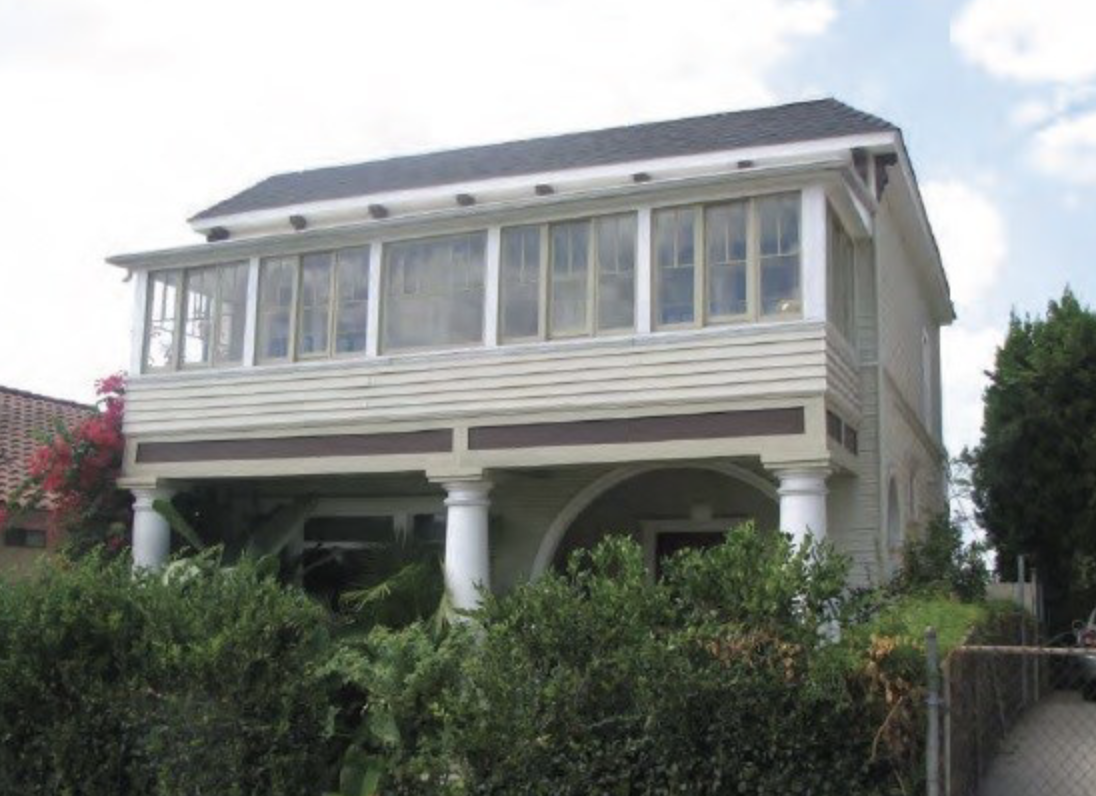
Among Echo Park historic homes, the Restovich House at 1001 N. Everett Street is the one built without an architect. Croatian-born restaurateur John Restovich put it up in 1905, a Neoclassical house facing Everett Park. It is Historic-Cultural Monument No. 1110 and sits just outside the Angelino Heights HPOZ, so monument review applies, not the HPOZ Board.
Powered by Side: #1 California-based brokerage, No. 9 in the nation.
Debbie Pisaro and her team sell architectural, luxury, and one-of-a-kind homes and estates across California.
A restaurateur's Neoclassical house on a ridge above Everett Park, on the one stretch of the old Angelino Heights tract that every Echo Park realtor learns sits outside the district line.
What is the Restovich House on Everett Street?
The Restovich House is a two-story frame house at 1001 N. Everett Street, Los Angeles, CA 90026, finished in 1905 for a family by the man whose family it was. It sits at the crest of a ridge facing Everett Park, the teardrop-shaped park at the top of Everett Street, on the eastern edge of Echo Park. Angelino Heights is known for its Eastlake and Queen Anne Victorians, and the 1300 block of Carroll Avenue is listed on the National Register of Historic Places. This house is something else: a classical box with a full-width porch on three Tuscan columns, built by a restaurant owner with no architect, just outside the line that protects its famous neighbors.
For anyone weighing Echo Park historic homes, that combination is the useful part. The Restovich House is protected, but not by the district everyone talks about. It was designated on its own, and the rules that follow from that are different from the rules a block away. Debbie Pisaro does not hold a listing on this house, and this is a record of the house, not a listing. It is written for owners of houses like it, and for buyers who search for historic homes in Echo Park by name and by street.
Stay in touch
Field notes on Echo Park, Angelino Heights and the rest of the Eastside's historic homes, from Debbie Pisaro of Coastline 840. Call or text Debbie directly.
(310) 362-6429Who was John Restovich?
John Restovich was born in Dalmatia, on the Croatian coast, and SurveyLA says he arrived in Los Angeles in 1885, at about age 24. He found work as a waiter. The 1894 city directory places him at the National Restaurant with two brothers, George and Evin, and he later owned a restaurant of his own, which is what paid for the land and the house. He married Rose in 1889, and of their six children, four were living at the 1910 census. The family belonged to St. Anthony's Croatian Catholic Church on Alpine Street.
The paperwork on the house is plain. The building permit cited in the City's record, No. 4750, dated October 2, 1905, covers a two-story, seven-room, 30 by 30 foot frame dwelling at a cost of $1,250. The owner is J. Restovich, the contractor is the owner, and no architect is named. SurveyLA says the house was built without the benefit of an architect or designer, and the City's 2015 staff report suggests the Neoclassical design may have been meant to recall the coastal houses of the Dalmatia he grew up in. No document in the record says what he actually drew from, so that stays a suggestion here.
John died on June 23, 1924, at 63. Rose lived in the house until her death in 1941, and the property stayed in the Restovich family until 2000, close to a century in one family's hands. That continuity is a large part of why the house reads as intact today: nobody bought it to start over.
How is the lot tied to the Benton Residence?
The lot has its own chain. William W. Stilson, who filed the Angelino Heights subdivision with Everett E. Hall in 1886, died with lots unsold, and his widow, Mary Stilson, took charge of the tract. She commissioned speculative houses from the firm of Aiken and Benton to help move the remaining lots. Around 1900 she sold Lot 30 to Timothy S. Abbott, who sold it to John Restovich, and he built on it in 1905.
Arthur B. Benton, of that firm, had bought one of those speculative houses himself in 1896 and lived in it for thirty-one years. It is now Historic-Cultural Monument No. 827, and its story is told in Just Silver Lake's field notes on the Arthur B. Benton Residence on Kensington Road. The two lots sit in the same tract and the two stories run in opposite directions: one spec house drawn by a celebrated architect and kept by him, one house drawn by nobody and kept by a family for ninety-five years.
One house in the tract was drawn by a famous architect. This one was drawn by nobody.
Is the Restovich House inside the Angelino Heights HPOZ?
No. The City's 2015 staff report on the house says the land on Everett Street around Everett Park was part of the original Angelino Heights subdivision but is not part of the Angelino Heights Historic Preservation Overlay Zone, and the zoning record it cites lists no overlay. That means the house has no HPOZ contributor or non-contributor status at all, because that label only exists inside the zone. The record does not say why the line was drawn where it was.
Angelino Heights became the first HPOZ in Los Angeles when the City Council adopted it in 1983, and it operates under a Preservation Plan dated June 10, 2004. Inside the zone, an HPOZ Board reviews exterior work against that plan. Debbie Pisaro's earlier record of the Angelino Heights HPOZ and Carroll Avenue covers the district side of the line. An Echo Park owner outside any HPOZ and without an individual designation has no preservation review and no route to the Mills Act. The Restovich House is the in-between case: outside the zone, and still protected, because it was designated on its own.
That is also why the wording here is careful. SurveyLA evaluated the house and found it eligible for the National Register, the California Register and local designation, calling it a rare, intact example of early residential development in the area. A finding of eligibility is not a designation. The designation came afterward: the Cultural Heritage Commission voted 5-0 on January 21, 2016 to recommend it, and the City Council adopted it as Historic-Cultural Monument No. 1110 later that year.
The Restovich House is outside the Angelino Heights HPOZ, so it has no contributor status. Its protection comes from its own monument designation.
What does monument status change for an owner?
For a monument outside an HPOZ, review runs through City Planning's Office of Historic Resources and the Cultural Heritage Commission rather than through an HPOZ Board. A remodel, a demolition permit or a major exterior change is the moment the designation shows up, so the owner's practical question is which permits get routed for review. Ask the Office of Historic Resources before you design anything, because the path depends on the permit type.
Monument status also opens the Mills Act, the California law that lets a city contract with an owner for a reduced property tax assessment in exchange for preserving and maintaining the house. In Los Angeles the contract runs ten years, renews each year, and transfers to the next owner. A property qualifies as a designated monument or as a contributor to an HPOZ, and the Restovich House qualifies on the first ground. Eligibility and a recorded contract are different things. The record reviewed for this post shows no contract on the house, so none is claimed. How a recorded contract behaves at a sale is set out in the network's guide to selling a Mills Act or HCM home, and what designation does to value is in how historic designation affects home value. Program windows and rules change, so confirm both with the City.
The same pattern holds across Echo Park. The Atwater Bungalows, Echo Park's Historic-Cultural Monument No. 1241, sit outside any district too, and that page walks through what an owner can and cannot remodel on a monument. Read together, the two show the same rule from two directions: the designation protects what it names, and it does not freeze a house.
Off market
Many of the homes she sells never reach the open market. Ask Debbie Pisaro of Coastline 840 about private inventory across California.
Join the Pocket Listings listWhat should you pull before selling a monument outside an HPOZ?
Owners of designated houses outside an HPOZ should assemble five documents before the first showing: the designation record and the Commission's staff report, the SurveyLA entry, a zoning record showing which overlays apply, any recorded Mills Act contract, and the permit history. For this house the permit history includes the 1905 permit and a 1967 rehabilitation permit whose scope the public record does not describe. Pull the file and find out what that work was before a buyer's inspector asks.
Then write down the character-defining features while you can still point at them: the three Tuscan porch columns and the arched opening to the door, the matching arch in the enclosed sleeping porch, the wood clapboard in two widths, the corbeled eaves, and, inside, the hardwood floors, wainscoting, built-in buffet and the mantel with Ionic columns. The first line of the listing should say Historic-Cultural Monument, the year, who built it, and that it faces Everett Park. Leave the price, the status and the adjectives for later.
A house with no architect is priced differently from a house with a famous one, and the record is what carries it. Debbie Pisaro sets out that logic in how a one-of-a-kind architectural home is priced, and for a number on a specific house she starts with a private home valuation built on historic comparables.
Outside the line and still protected, because it was designated on its own.
Everett Park and the houses around it
The house looks out over Everett Park, which carries the name of Everett E. Hall, Stilson's partner in the original subdivision. The 2015 report places this stretch northeast of Sunset Boulevard, across from the Victorian rows of the district. The rest of the tract tells other stories: the Ellis-Norton house, a Bunker Hill Victorian moved to Angelino Heights, written up in Debbie Pisaro's page on the Ellis-Norton house, and the Eastlake and Queen Anne rows of the HPOZ. For the neighborhood's other small green spaces, see the network's guide to the best small parks in Silver Lake and Echo Park.
Over in Echo Park proper, the Ross House by Raphael Soriano shows what the same neighborhood built a generation later, and the work of architect A.F. Leicht, whose name is tied to Angelus Temple down the hill, is another end of the neighborhood's story. For the Silver Lake side of the same community plan area, where the rules differ again, see the Silver Lake architecture guide, and for the architects behind the houses on all of these streets, the architects guide.
The pattern is a California one. The Mills Act is state law, Angelino Heights was the first of what became dozens of HPOZs across Los Angeles, and the idea that a modest immigrant-built house is worth protecting is one Debbie Pisaro sees in her work from the Eastside to Ojai and the coast. Her practice and the way she handles historic houses are described on her historic and architectural real estate agent page, and the rest of Echo Park, Silver Lake and Northeast Los Angeles is on Just Silver Lake.
What the record does not show
The public record does not name an architect, and SurveyLA says Restovich built the house without one. It does not show a recorded Mills Act contract. It does not describe the 1967 work. The sources disagree on the roof, which one describes as a low hipped roof and another as flat behind a parapet, and they disagree on exactly when Restovich arrived and when the tract was subdivided. No ownership, price or listing status is stated here, and none should be inferred. Treat the details in this post as the record, not a survey of the house today.
Why the Restovich House stays with me
What struck me first was the clapboard. The record describes wood siding in two widths, and that's a builder's choice, not an architect's flourish. John Restovich wasn't trying to impress a client. He was building for his own family, and you can read that in the wood.
The house does one thing very well: it stays put. Ninety-five years with one family means nobody gutted it to start over. The three Tuscan columns are still holding up the porch, the buffet is still built in, and the mantel still has its Ionic columns. That kind of continuity is rare anywhere in Los Angeles, and it's worth more than any name on a permit.
I picture someone who'd rather own an honest house than a famous one. A buyer who likes the idea of living across from a park, a block outside the district's rules, in a house a waiter-turned-restaurateur paid for himself. Someone who wants the story to be about the people who lived there.
The honest part is the paperwork. There's a 1967 rehabilitation permit nobody has described, and the sources can't agree on the roof. If this house were mine to sell, pulling that permit file, confirming the review path with the Office of Historic Resources, and checking title for any Mills Act contract would be my homework before a single photo.
Bottom line: a house built by nobody in particular, kept by one family for most of a century, is exactly the kind of Echo Park history worth protecting.
Frequently asked questions
Where is the Restovich House?
The Restovich House is at 1001 N. Everett Street, Los Angeles, CA 90026, at the crest of a ridge facing Everett Park on the eastern edge of Echo Park. It is a two-story 1905 Neoclassical house with a full-width porch on three Tuscan columns, just outside the Angelino Heights Historic Preservation Overlay Zone. It is a private residence.
Is the Restovich House inside the Angelino Heights HPOZ?
No. The City's 2015 staff report says the land around Everett Park was part of the original Angelino Heights subdivision but is not part of the HPOZ, and the zoning record listed no overlay. Because the lot is outside the zone, it has no HPOZ contributor status. Its protection comes from its own monument designation instead.
When did the Restovich House become a Historic-Cultural Monument?
The Cultural Heritage Commission voted 5-0 on January 21, 2016 to recommend the Restovich House, and the City Council adopted it that year as Los Angeles Historic-Cultural Monument No. 1110. SurveyLA had already found it eligible, calling it a rare, intact example of early residential development in the area. Eligibility alone designated nothing.
Who designed the Restovich House?
No architect designed it. The 1905 building permit cited in the City's record lists owner J. Restovich as his own contractor and names no architect, and SurveyLA says the house was built without an architect or designer. John Restovich, a Croatian-born restaurateur, built it as a seven-room frame house for his family.
Does designation open the Mills Act?
Yes. In Los Angeles a property qualifies for a Mills Act contract as a designated monument or as an HPOZ contributor, and the Restovich House qualifies as a monument. Eligibility is not a contract. The record reviewed for this post shows no recorded contract, so a buyer should ask for the recorded documents rather than assume one exists.
What changes outside an HPOZ?
There is no HPOZ Board and no contributor review. Demolition and exterior alteration questions go through City Planning's Office of Historic Resources and the Cultural Heritage Commission process that governs monuments. Confirm the review path with the Office of Historic Resources before you plan a remodel, because which permits get routed depends on the work.
How do you research Echo Park historic homes?
Start with the record, not the listing photos. Check whether the house is a Historic-Cultural Monument, whether it sits inside the Angelino Heights HPOZ, the only HPOZ in Echo Park, and what SurveyLA found. Then pull the permit history and any recorded Mills Act contract. The boundary and the designation decide which rules apply.
Who is a good real estate agent in Echo Park for historic homes?
Debbie Pisaro of Coastline 840 works with buyers and sellers of historic and architect-designed houses in Echo Park, Angelino Heights, Silver Lake and across California. She reads the designation, zoning and permit record before a house is priced. She is an Inman Luxury Leader, DRE #01369110, with an office at 160 Glendale Blvd in Echo Park.
Buying or selling in Echo Park
Work with Debbie Pisaro
Debbie Pisaro of Coastline 840 will read the designation and zoning record on an Echo Park or Angelino Heights house before it becomes a negotiation. Debbie represents buyers on architectural and historic homes across California, regardless of who holds a given listing. I reply to every new inquiry within one business day.
(310) 362-6429 · debbie@coastline840.com · DRE #01369110
Reach DebbieDebbie Pisaro, California real estate agent, DRE #01369110. Coastline 840 is a brand/DBA of Side, Inc., CA DRE #02014153, responsible broker.
Debbie Pisaro is a 24-year veteran, founder of Coastline 840, and an Inman Luxury Leader, representing buyers and sellers across Echo Park, Angelino Heights and the surrounding neighborhoods. Many of the homes she sells never reach the open market. For anyone looking for an Echo Park realtor who starts with the record, that is the method on every house.
Debbie Pisaro of Coastline 840 · California real estate agent, DRE #01369110 · Inman Luxury Leader · About Debbie
Sources include the City of Los Angeles Cultural Heritage Commission staff reports for the Restovich House (CHC-2015-4006-HCM), the SurveyLA survey of Silver Lake, Echo Park and Elysian Valley, the Angelino Heights HPOZ Preservation Plan, and the Historian 4 Hire monument catalog. General information, not legal or tax advice. Equal Housing Opportunity.
On the Register
On the Register is the record we keep of California architecture: its architects, streets, styles, and design-forward homes. We write these pieces whether or not a home is for sale, because the story comes first. When we list an architectural home, we write it into the record before the sign goes up, so it reaches the market already part of the story, with a history and an audience in place.
© 2026 Debbie Pisaro, Coastline 840 · ontheregister.com