
The short answer
Searching mid century modern homes for sale Silver Lake? The neighborhood’s modern story starts earlier, at the Lipetz House, 1843 N. Dillon Street. Raphael Soriano designed it in 1936 for a concert pianist, and it became Los Angeles Historic-Cultural Monument 967 in 2009. It is a private residence, not a listing.
Powered by Side: #1 California-based brokerage, No. 9 in the nation.
Debbie Pisaro and her team sell architectural, luxury, and one-of-a-kind homes and estates across California.
The steel and aluminum pioneer began with a curved room for a Bechstein grand, and what Monument 967 means for an owner in a neighborhood with no overlay zone.
The steel pioneer began with a piano
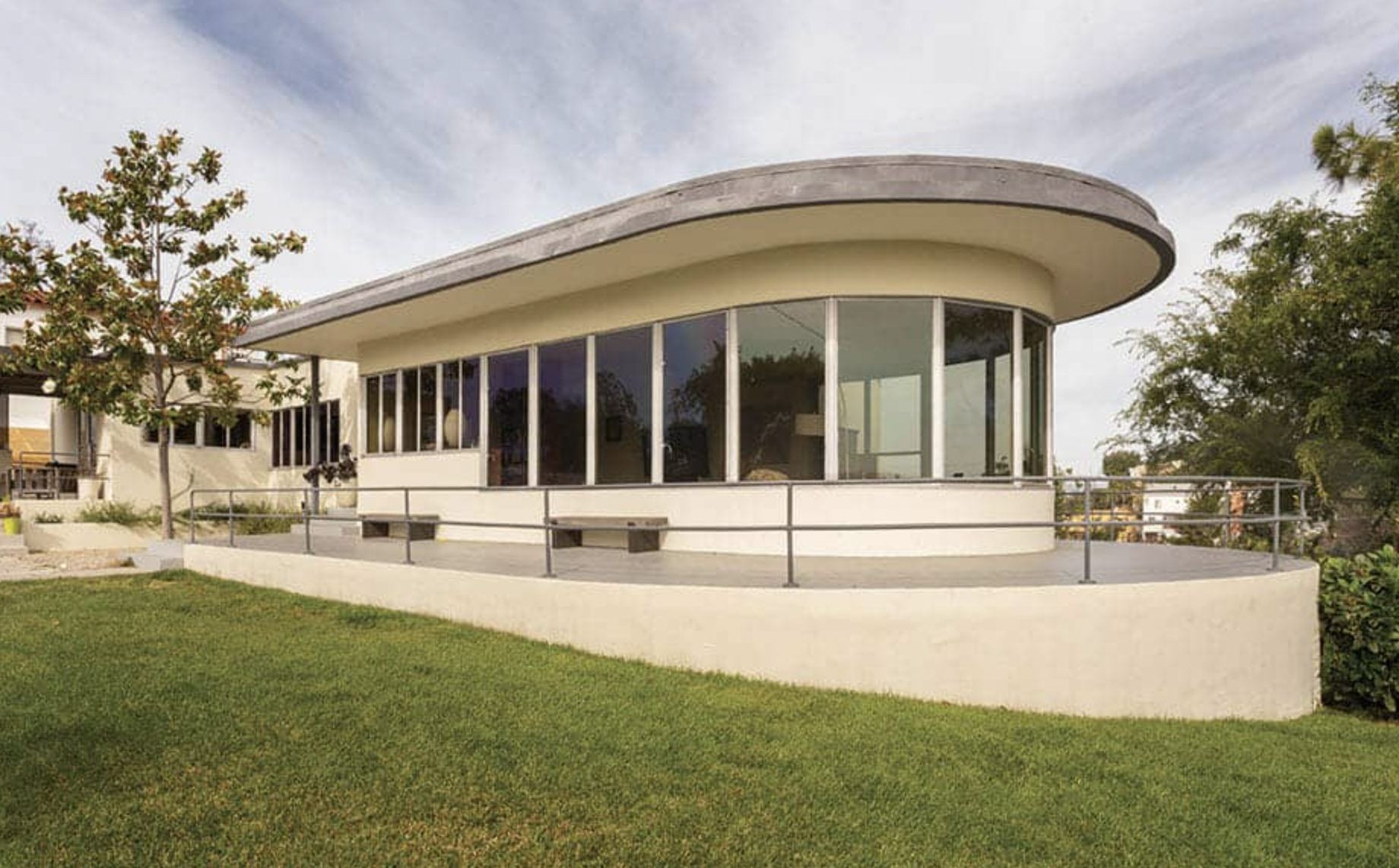
Lipetz House. 1843 North Dillon Street, Los Angeles, CA 90026 (Silver Lake). Architect: Raphael Soriano. Built: 1936. Designation: Los Angeles Historic-Cultural Monument 967, adopted September 23, 2009. Style: Streamline Moderne and International Style.
Raphael Soriano is remembered for steel and aluminum. He framed the first residential steel house in his region, built a Case Study House, designed an all-steel house for the developer Joseph Eichler in Palo Alto, and finished with prefabricated aluminum homes on Maui. The Lipetz House is none of that. It is a curved, white-stucco house built around a music room for a concert pianist.
The room is the reason for the house. Wikipedia and the Pacific Coast Architecture Database both describe it as sized for Helen Lipetz’s Bechstein grand piano and for a small audience, and as taking up close to a third of the floor area. The north end of the house is a semicircle of continuous windows facing the San Gabriel Mountains. The man who spent his career arguing that houses should be assembled from a system started with a room shaped around a piece of furniture. That is the first thing a Silver Lake realtor should say about this address.
The City’s own staff report adds a second twist. The house was completed before Soriano was licensed as an architect. The report also says he appears to have met the photographer Julius Shulman at this property, which began a collaboration that later produced some of the most recognizable photographs of Los Angeles modernism.
Stay in touch
New Silver Lake house histories are added as they are written. Join the list to hear about the next one.
Join the Silver Lake listOr call Debbie directly: (310) 362-6429
Raphael Soriano, before the steel
Soriano was born on the island of Rhodes and reached Los Angeles in 1924. He studied architecture at the University of Southern California, graduating in 1934. In 1931 he took an internship with Richard Neutra, working alongside Gregory Ain and Harwell Hamilton Harris, and in 1934 he spent a short time with Rudolph Schindler. While lecturing at USC he received his first private residential commissions, and the Lipetz House was among them.
His first large commission followed in 1939, the Soto-Michigan Jewish Community Center, which was demolished in 2006. Then came the work he is known for: his 1950 house and studio for Shulman, his Case Study House of the same year in Pacific Palisades, and the Colby Apartments, which won a national American Institute of Architects design award and came down in 1988. He moved to Tiburon in 1953, built the all-steel house for Eichler in Palo Alto in 1955, became a Fellow of the AIA in 1961, and founded Soria Structures in 1965 to make aluminum homes. He died in 1988.
Very little of it survived. Debbie Pisaro’s Raphael Soriano architect page gives the count from Cal Poly Pomona, which holds his drawings: roughly 151 designs, about thirty-one built, and about a dozen standing. Six of those are Historic-Cultural Monuments. Her pages also cover the 1938 Ross House in Echo Park, Monument 964, and the Katz House, his first steel-framed house. Los Feliz Living covers the Gogol House and the Schrage House. The Lipetz House is where all of them begin.
The steel pioneer started with a room shaped around a piano.
What the record says it is
The staff report describes a one-story house of Streamline Moderne and International Style design on an elongated, irregular plan along a north and south axis. It has a flat roof, a stucco skin, an emphasis on horizontal lines, an asymmetrical facade, and curved corners wrapped in continuous windows. A walkway and a half flight of stairs lead to a recessed entrance. The north wing is U-shaped and lined with steel casement windows, and a balcony with curved pipe rails runs beside the entrance porch. Inside, the report singles out built-in wood cabinetry and recessed lighting.
Sources differ on how it was built. The City report describes cast concrete sheathed in stucco, while Wikipedia and the Pacific Coast Architecture Database describe wood-frame construction, with Wikipedia adding steel beams under the ground floor. This page does not choose between them. Debbie Pisaro’s Soriano page calls it a house with no steel in it at all, so the steel beams are worth checking too. Sources also differ on size, which is a good reminder to measure and verify before any claim reaches a listing.
The same report records the changes. The garage was replaced by a covered carport in the 1950s. The south patio and the rooftop deck above the carport are later additions. The entrance steps were replaced and relocated, a wall between the kitchen and dining room was removed, cedar closet doors and Carrara glass in the bedrooms were removed, and the cork flooring was replaced. The steel casement windows were restored. The report concludes that the original floor plan appears to be essentially intact.
One claim needs correcting. The house was one of five American buildings shown at the 1937 International Exhibition in Paris, a detail that comes from secondary sources, since the staff report does not mention Paris. Wikipedia and the Pacific Coast Architecture Database go further and say it won Soriano the Prix de Rome. Debbie Pisaro’s Soriano page explains why that does not hold up: he did not win it, and the Paris showing seems to have turned into a prize somewhere downstream.
What Monument 967 changes for an owner
Los Angeles designates Historic-Cultural Monuments through the Cultural Heritage Commission, which recommends, and the City Council, which decides. City Planning’s Office of Historic Resources administers the program. The Lipetz nomination was an owner application. The Commission took it under consideration on May 21, 2009, a July 16, 2009 staff report recommended designation on two grounds, that the house is an architectural type specimen of its style and the work of a master architect, and the City’s monument list records adoption on September 23, 2009, under council file 09-1849.
For an owner, the day-to-day consequence is review. Office of Historic Resources staff review proposed work before alteration permits are issued, and the Commission reviews exterior and interior alterations against the Secretary of the Interior’s Standards for Rehabilitation. Designation does not prohibit demolition. The Commission can object to a demolition permit and delay it up to 180 days, with one 180-day extension if the City Council approves, and a monument is presumed to be a significant historical resource under the California Environmental Quality Act. Once a complete nomination is filed, a temporary stay applies to demolition and significant alteration while it is considered. An owner’s consent is not required for designation, though owners usually take part.
Debbie Pisaro has written about this from the Los Feliz side in how Historic-Cultural Monument designation affects home value. The Silver Lake version has one twist of its own.
Off market
Many of the homes she sells never reach the open market. Ask Debbie Pisaro of Coastline 840 about private inventory across California, including architectural houses in Silver Lake.
Join the Pocket Listings listSilver Lake has no preservation overlay, and that cuts both ways
The City’s list of adopted Historic Preservation Overlay Zones does not include Silver Lake. Angelino Heights, the first, sits in the same community plan area but is a different neighborhood. For a Silver Lake owner the result is counterintuitive. A significant house that is not individually designated has no design review standing between its owner and an exterior change. It also has no route to the Mills Act, which requires either monument status or contributor status in an overlay zone, and there is no Silver Lake overlay to be a contributor to.
So designation here is a trade, not pure upside. The owner who nominated the Lipetz House accepted review in exchange for protection. The owner of an unprotected Silver Lake modernist house keeps the freedom to change it, and so does every future buyer. A buyer who wants a Soriano, Neutra, or Schindler house to stay as drawn should check the designation status first, because the neighborhood will not do it for them. The Hawk House on Silver Ridge Avenue took the same road a decade later.
Eligible is not a recorded contract
The Mills Act in Los Angeles is a revolving ten-year contract between the City and the owner, renewed automatically each year, and it passes to the next owner when the property sells. Monument status is what makes the Lipetz House eligible. That is different from holding a recorded contract, and the records reviewed for this page show the designation but no contract, so this page makes no claim that one exists.
Eligible also does not mean the door is open. The Los Angeles Conservancy reports that the City has not accepted new contracts since 2020, and that City Planning released draft recommendations to revive the program in March 2025. Anyone relying on the program should confirm its status with the Office of Historic Resources first. The Mills Act guide on Just West Adams covers what a closed door means for a house, and the guide for Los Feliz sellers walks through the seller’s questions.
Eligible is not enrolled. Whether a house carries a recorded Mills Act contract is confirmed with the Office of Historic Resources and the title record, never from a listing.
Surveyed is not designated
Many Silver Lake houses have been surveyed and found eligible without ever being designated. SurveyLA, the City’s survey, produced a report for the Silver Lake, Echo Park, and Elysian Valley area. City Planning says plainly that no designation results directly from survey activity. An eligibility finding creates no review and no Mills Act route. It is still useful to pull, because it records what a trained surveyor thought mattered about a house. Keep the two words apart in a listing, in a conversation, and in your head.
If you own a house like this
Debbie Pisaro is not the listing agent for the Lipetz House. This section is for the owner of a Silver Lake house with a pedigree who is thinking about selling.
Start with the paper. Pull the designation staff report, which for this house is case CHC-2009-1391-HCM, or the SurveyLA evaluation if the house was only surveyed. Pull the list of character-defining features, and compare it with what is on the lot today. Pull any record of a Mills Act contract from the Office of Historic Resources and the title file, and note the difference between eligible and enrolled. Gather the permit history, because past alterations like a rooftop deck or a relocated stair are part of the story a buyer will ask about.
Then write the first line of the listing around the record, not the adjectives. Name the architect, the year, and the monument number. If the house is a monument, say what that means for the next owner in one plain sentence about review, and if it is not, say that no overlay zone governs the street. Buyers of houses like this are often out-of-state or international, and they shop the architect before the zip code, so a Silver Lake realtor who can cite the file is worth more to them than one with a longer adjectives list. Debbie Pisaro’s page on working with an architectural homes specialist explains how she does it, and Coastline 840’s home valuation page gives a starting number.
On its street, and in California
The house stands on Dillon Street in the Bonnie View Tract, above the Silver Lake Reservoir. Directly across the street, Soriano built the 500-square-foot Dodie Priver House in 1937. It was demolished within about a decade. A newer neighbor has been more careful: the house Architectural Record credits to Barbara Bestor’s firm steps down a hill on the same property, was completed in 2020, and has a peaked roofline shaped so that it does not block the views from the historic house. Elsewhere in the neighborhood, Schindler’s Wilson House, Monument 965 at 2090 N. Redcliff Street, was adopted the same day as the Lipetz House, and the Moreno Highlands and the Neutra Colony are mapped in the Silver Lake architecture guide.
Silver Lake holds one of the deepest concentrations of modernist housing in California, and Soriano connects it to the rest of the state: Pacific Palisades, Palo Alto, Tiburon, and on through the aluminum Grossman House in Studio City. Debbie Pisaro’s California practice follows architects, not zip codes, and debbiepisaro.com does the same. Her Gogol House page notes that Soriano built five houses between 1936 and 1939 within roughly a mile of each other. The Lipetz House was the first.
I remember standing on Dillon Street and feeling that the house was somehow both unexpected and completely at home there. The curved windows, the quiet white walls, and the way it seemed to open toward the mountains made it feel less like a house designed to impress and more like a house designed to live beautifully.
What is not known
The City’s staff report does not name the original owners beyond what other sources say, and it gives no building permit. This page relies on the Pacific Coast Architecture Database and USModernist for the Lipetz names and for the Paris claim. SurveyLA dates the house to 1935, while the City’s report and most other sources say 1936. Architect birth years differ between sources, and so do size and construction type. No record of a Mills Act contract turned up, nor any sale history worth citing, nor interior photographs beyond the staff report’s description. Nothing here describes the house’s current condition.
Sources: City of Los Angeles Department of City Planning, Lipetz House staff reports, case CHC-2009-1391-HCM; City Planning, Historic-Cultural Monuments list; City Planning, Historic-Cultural Monument Process FAQs; City Planning, Local Historic Districts (HPOZs); City Planning, Mills Act Historical Property Contract Program; Los Angeles Conservancy, City of Los Angeles Mills Act Program; SurveyLA, Historic Resources Survey Report, Silver Lake, Echo Park, and Elysian Valley; Wikipedia, Lipetz House; Pacific Coast Architecture Database; USModernist, Raphael Soriano; Architectural Record.
Frequently asked
Where is the Lipetz House?
The Lipetz House is at 1843 N. Dillon Street, Los Angeles, CA 90026, on a hilltop in the Bonnie View Tract above the Silver Lake Reservoir. It is a private residence that is not open to the public, and Debbie Pisaro is not its listing agent, so please enjoy it from the street.
Who designed the Lipetz House?
Raphael Soriano designed it in 1936 for Emanuel and Helen Lipetz. Soriano trained at USC, drafted for Richard Neutra, and briefly worked for Rudolph Schindler. The City’s staff report says the house was finished before he held an architect’s license, and it is generally treated as his first house.
Is the Lipetz House a Historic-Cultural Monument?
Yes. It is Los Angeles Historic-Cultural Monument 967, adopted September 23, 2009, under case CHC-2009-1391-HCM and council file 09-1849. The staff report found it an architectural type specimen of Streamline Moderne and International Style design, and the work of a master architect.
Is the Lipetz House mid century?
No. At 1936 it is pre-war modernism, a decade before the mid century label fits. Silver Lake holds early modern, International Style, and mid century houses side by side, which is why a buyer searching for one should ask an agent to check the year and the record for each house.
Is there a historic district protecting Silver Lake houses?
No. The City of Los Angeles keeps a list of adopted Historic Preservation Overlay Zones, and Silver Lake is not on it. A Silver Lake house gets preservation review only if it is individually designated, as the Lipetz House is. A house surveyed as eligible has no design review and no Mills Act route.
What does Monument status change?
City Planning’s Office of Historic Resources reviews proposed alterations before permits issue, applying the Secretary of the Interior’s Standards. Designation does not bar demolition, but the Commission can object and delay a permit for up to 180 days, with one possible 180-day extension if the City Council approves.
Does the Lipetz House have a Mills Act contract?
No record reviewed for this page shows one, so this page does not claim it. Monument status is what makes a house eligible, and the Los Angeles Conservancy reports the City has not accepted new contracts since 2020. Confirm any contract with the Office of Historic Resources and the title record.
What is the difference between SurveyLA eligibility and designation?
SurveyLA, the City’s survey of historic resources, flags properties that may qualify. City Planning states that no actual designation results directly from survey activity. Eligibility imposes no review and opens no Mills Act route. Designation takes a separate nomination, a Cultural Heritage Commission recommendation, and a City Council vote.
What should a Silver Lake realtor pull before listing a designated house like this?
Pull the designation staff report, the SurveyLA evaluation, a list of character-defining features, the permit history, and any recorded Mills Act contract. Put the architect, the year, and the Monument number in the first line of the listing. Debbie Pisaro can walk you through each record before a photographer arrives.
Who is a good full-service real estate agent in Silver Lake?
Look for an agent who reads the record as well as the market. Debbie Pisaro of Coastline 840 works with buyers and sellers across Silver Lake, Echo Park, and the rest of California, on architectural houses and ordinary ones alike, and her office is just over the line on Glendale Boulevard.
Buying or selling
Work with Debbie
Debbie Pisaro of Coastline 840 represents buyers on architectural and historic homes across California, regardless of who holds a given listing. If you own a Silver Lake house with an architect’s name on it, she is glad to talk it through.
(310) 362-6429 · debbie@coastline840.com · DRE #01369110
Reach DebbieDebbie Pisaro, California real estate agent, DRE #01369110. Coastline 840 is a brand/DBA of Side, Inc., CA DRE #02014153, responsible broker.
By Debbie Pisaro, a 24-year veteran, the founder of Coastline 840, and an Inman Luxury Leader · California real estate agent, DRE #01369110 · About Debbie
On the Register
On the Register is the record we keep of California architecture: its architects, streets, styles, and design-forward homes. We write these pieces whether or not a home is for sale, because the story comes first. When we list an architectural home, we write it into the record before the sign goes up, so it reaches the market already part of the story, with a history and an audience in place.
© 2026 Debbie Pisaro, Coastline 840 · ontheregister.com