
The short answer
Silver Lake modernist homes for sale rarely carry a record like the Edward A. “Tink” Adams House at 2331 Cove Avenue. It is Los Angeles Historic-Cultural Monument No. 922, a 1906 bungalow that the founder of the Art Center School had rebuilt over four decades by architects who taught at his school.
Powered by Side: #1 California-based brokerage, No. 9 in the nation.
Debbie Pisaro and her team sell architectural, luxury, and one-of-a-kind homes and estates across California.
The Cove Avenue house the Art Center founder handed to his own faculty, and what Monument No. 922 means for an owner.
A 1906 bungalow that kept growing
The house at 2331 Cove Avenue began around 1906 as a hipped-roof bungalow on a ridgeline with a view of the Silver Lake Reservoir. Edward A. “Tink” Adams and his wife, Virginia, bought it in 1942. What stands there now is not the work of one architect and not the work of one decade.
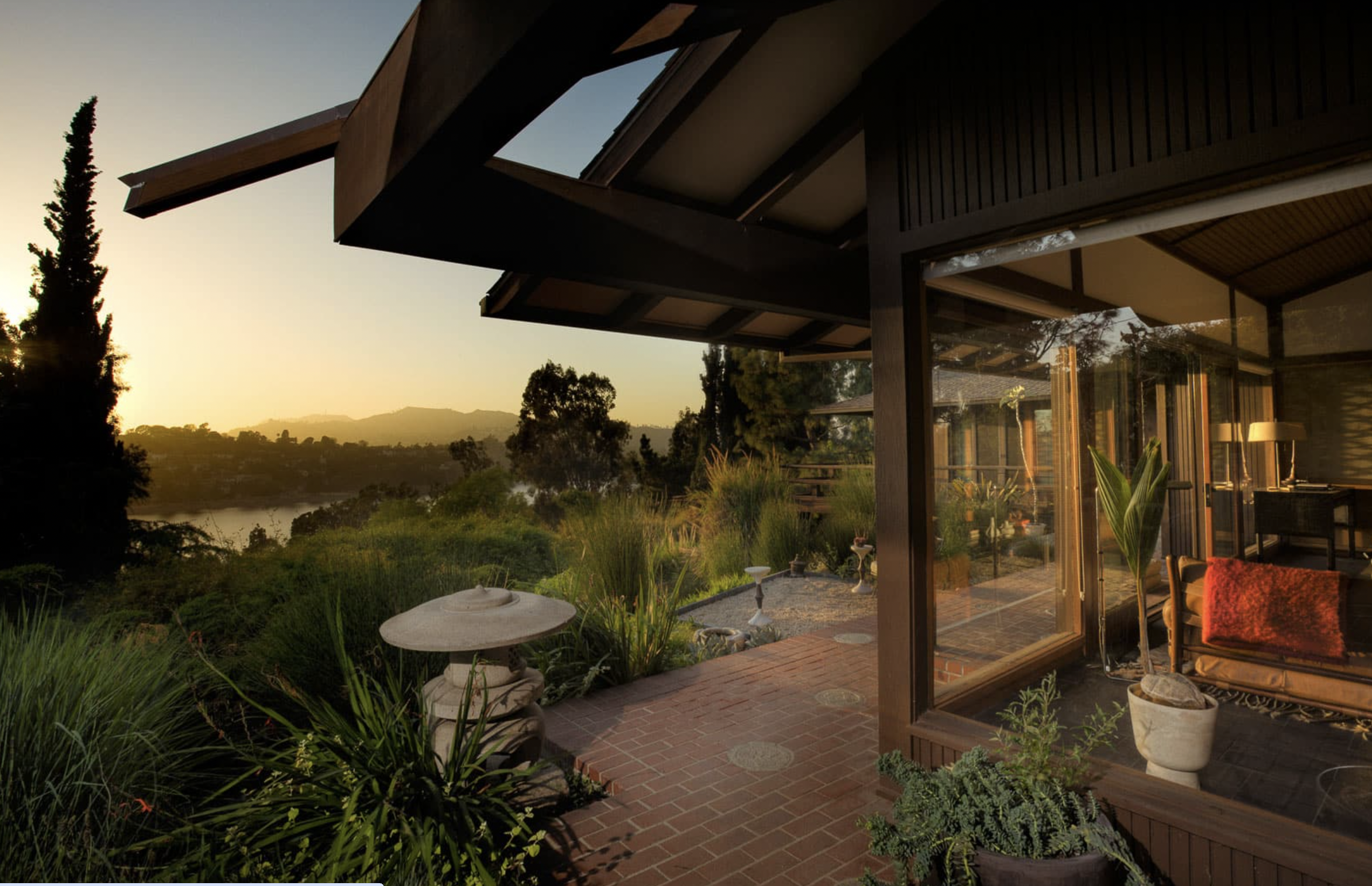
The designation summary describes a one-story house in the International Style with traditional Japanese elements. It has an L-shaped plan, a low-pitched gable with exposed eaves, board-and-batten cladding in wood and glass, and a flared front gable carrying an exposed beam with a metal cap in a Japanese manner. Concrete and brick decks include a partly cantilevered one with angular beams. A large brick chimney serves an outdoor fireplace and barbecue at the rear, and a Japanese-style garden surrounds the house. It folds in the structure of the 1906 bungalow, a modernist garage, and a concrete rear deck. Accounts differ on the garage, dating it to 1948 or 1949.
Here is the twist. The house reads as a long conversation among several architects. One account says Adams wanted it to serve as the palette on which architects could express their art, and the architects he chose were people who taught at his school. The last of them finished a wing after the one before him had died.
Stay in touch
New Silver Lake house histories are added as they are written. Join the list to hear about the next one.
Join the Silver Lake listOr call Debbie directly: (310) 362-6429
The man who started an art school
ArtCenter’s own history names advertising man Edward “Tink” Adams as co-founder and first president. The school opened in 1930 in a courtyard of buildings on West Seventh Street in Los Angeles, with 12 teachers and eight students. Adams had grown frustrated with the work of recent art school graduates, and he built a practical curriculum for publishing, advertising, and industrial design.
The growth was fast. By 1940 enrollment reached nearly 500 students from 37 states and several other countries. The school moved to a larger building on Third Street in 1946, founded its Automotive Design Department in 1948, and became an accredited four-year college in 1949. It moved to its Hillside Campus in Pasadena in 1976. Other accounts date the first classes to 1931 and have Adams serving as president until 1965 and board chairman until his death in 1981.
Set that against the house. Adams ran a school that taught people to design for publishing, advertising, and industry, and at home he handed the design problem to the instructors one project at a time. The institution has its own story, and ArtCenter tells it. This post stays with the house on Cove Avenue.
The faculty who built it
John Rex and Douglas Honnold. In 1955, per the archive record, Adams commissioned Rex and Honnold to design a garage, a grill, and a masonry deck. A second account credits Rex with the concrete and stone rear deck and Honnold with the chimney and barbecue area. One account says both men taught at the school and formed a partnership in 1953 that lasted until Honnold’s death in 1974.
Honnold was born in Montreal in 1901 and studied at Cornell and at the University of California, Berkeley. With George Vernon Russell he designed the Alexander Kiam House around 1927 and, with Arthur W. Hawes, the Hollywood Reporter Building on Sunset Boulevard in 1937. The Honnold and Russell name is also on the Dolores del Rio house in Santa Monica Canyon. After the war, Honnold and Rex worked on the Anderson House in Bel Air and the Romanoff restaurant in Beverly Hills, both in 1951, and Honnold’s later work included the Los Angeles Hall of Records with Richard Neutra and others.
A. Albert Cooling. In 1966, most of the house was rebuilt from a plan by Cooling, described as another Art Center instructor. He died before the final phase was designed. The sources opened for this post contain no biography of him, and none is invented here. His name is on the record, and that is all the record gives.
James De Long. Adams then turned to De Long, a Taliesin Fellow who had spent the late 1940s at Taliesin West. De Long designed the master bedroom wing, and the permit was pulled in 1977. Construction was not finished until 1983, two years after Adams died. Debbie Pisaro’s page on James De Long’s Hackett House in Studio City shows the Wright lineage in his own work.
Harwell Hamilton Harris. The Pacific Coast Architecture Database lists Harris among the designers because he prepared residential designs for Adams in 1951. Those drawings are held in the Harwell Hamilton Harris Papers at the Alexander Architectural Archive, University of Texas Libraries. Nothing in the record shows they were built, so this post credits Harris with the drawings and nothing more. His built Silver Lake work includes the Hawk House on Silver Ridge Avenue, from 1939.
Adams handed the design problem to his own faculty, one project at a time.
What Monument No. 922 changes for an owner
Historic-Cultural Monument is the City of Los Angeles designation. A nomination goes to the Cultural Heritage Commission, which recommends, and the City Council makes the designation. The Adams House was designated on July 2, 2008, as No. 922. Anyone can submit a nomination, and owner support is not required.
For an owner, the label changes who reads your plans. The City’s published guidance says the Commission reviews proposed exterior and interior alterations against the Secretary of the Interior’s Standards for Rehabilitation, and Office of Historic Resources staff review and approve proposed work before alteration permits issue. The Commission can object to a demolition permit and hold it up to 180 days, and the Council can add one more 180 days. A monument is presumed to be a significant historical resource under the California Environmental Quality Act, so demolition brings environmental review. Designation does not make demolition impossible.
One more distinction. The City’s SurveyLA report for the Silver Lake, Echo Park, and Elysian Valley area, prepared in 2014, evaluated many houses as eligible for designation without designating them. An eligibility finding is an opinion about what could qualify. Designation is a legal act, and only designation triggers the review above. For how the label plays in a sale, Debbie Pisaro’s Los Feliz site covers selling a Mills Act or Historic-Cultural Monument home and how designation affects home value.
A house built in phases leaves phases in the file. The Adams House has a permit from 1977 that was not finished until 1983, so pull the full permit history before anyone writes a listing.
Silver Lake has no overlay, and that cuts both ways
Los Angeles has about three dozen Historic Preservation Overlay Zones, and none of them covers Silver Lake. Angelino Heights has one, the first in Los Angeles, and the Arthur B. Benton Residence sits inside it. Just outside its line, the Restovich House on Everett Street is a monument with no overlay, the same position as every designated house in Silver Lake. A Silver Lake house of real architectural weight that is not individually designated has no preservation design review standing between its owner and an exterior change. It also has no route to the Mills Act. Designation here is a trade, not pure upside: the same label that protects the house adds review to a remodel, and a buyer who wants to open a facade should learn that before an offer, not after.
A monument meets the eligibility test for the Mills Act, which in Los Angeles requires either monument designation or contributor status in an overlay zone. Because Silver Lake has no overlay zone, individual designation is the only way in. Eligibility and a recorded contract are different things. No record opened for this post shows a Mills Act contract on the Adams House, and this post does not claim one.
A Mills Act contract is a minimum ten-year agreement between the City and the owner, renewed automatically each year, which runs with the land and passes to a buyer on sale. It can lower assessed value, because the Assessor enrolls the lowest of three computed values. The Los Angeles Conservancy reports the City has taken no new contracts since beginning a program assessment in 2020, so for a Silver Lake owner the practical question is usually whether a contract already sits on the title. Confirm the program’s status with the Office of Historic Resources before you rely on it.
Off market
Many of the homes she sells never reach the open market. Ask Debbie Pisaro of Coastline 840 about private inventory across California, including architectural houses in Silver Lake.
Join the Pocket Listings listIf you own a house like this
Debbie Pisaro is not the listing agent for the Tink Adams House, and this post is a study of the public record, not a listing. This section is for the owner of a Silver Lake house with a long record who is thinking about selling.
Before you list a designated modernist house, pull four things. First, the designation record: the monument number, the case number, and the Council file number from the City’s monument list, plus the nomination text, which lists the character-defining features a buyer’s architect will read. Second, the full permit history. Third, any recorded Mills Act contract and its inspection history, confirmed with the Office of Historic Resources. Fourth, a plain statement of which architects are documented as built and which as designed only. If your house is not designated, pull the SurveyLA evaluation instead and describe it for what it is, an eligibility finding.
The first line of the listing should carry the designation number and the maker’s story. For this house it would read: Los Angeles Historic-Cultural Monument No. 922, the Art Center founder’s own house, finished by his faculty. A buyer cannot assemble that sentence alone. That is the work of an architectural homes specialist, and the quieter side of it is covered in how pocket listings work. For a number that accounts for architect, designation, and condition, start with Coastline 840’s home valuation page.
Designation here is a trade, not pure upside.
Cove Avenue and the California story
Cove Avenue sits in the hillside above the Silver Lake Reservoir, which is itself Historic-Cultural Monument No. 422. The Adams House has a monument neighbor on its own street: the O’Neill Duplex No. 1 at 2342 Cove Avenue, Historic-Cultural Monument No. 868, built in 1953 by Rodney Walker and designated May 16, 2007. Two monuments on one street, designated a year apart, make Cove Avenue worth a slow drive.
Further out, the neighborhood’s monument list reads like a short course in Southern California modernism. Richard Neutra’s VDL Research House at 2300 Silver Lake Boulevard is No. 640, his own street is covered in Neutra Place and the Neutra Colony, and the Richard Neutra architect page follows his work across the region. Schindler’s How House of 1925 is No. 895, and William Kesling’s Skinner House shows the Streamline Moderne side of the hills. John Lautner’s Baldwin House on Micheltorena Street, from 1955, sits on slender posts above a wooded slope. Debbie Pisaro’s Silver Lake architecture guide covers the wider hillside, and her architects guide indexes the rest.
Silver Lake holds one of the deepest concentrations of modernist housing in California, and much of it is organized around a famous name and a single commission. The Adams House reads differently. It belongs to a California habit: a Japanese building and garden tradition folded into a modernism with Frank Lloyd Wright behind it, in a state that was building its design schools at the same time. Art Center’s path from a courtyard on West Seventh Street to a hillside campus in Pasadena is a California story, and the house is where its founder lived while it happened. More Silver Lake houses are collected on the Just Silver Lake home page.
The record also leaves several things open, and this post does not fill them in. The architect of the original 1906 bungalow is not named in any source opened for it. Whether Harris’s 1951 drawings were ever built is not shown. The dates of the Rex and Honnold partnership come from a marketplace page, not a primary record. Sources differ on the garage date, on the founding year of the school, and on Adams’s titles at various points. Nothing opened for this post shows a recorded Mills Act contract, and none is claimed. The designation record itself, with its case and Council file numbers and the full list of character-defining features, is the document to read first.
Sources: Pacific Coast Architecture Database, Edward A. Adams House, building 14080; ArtCenter College of Design, history of the school; City Planning, Historic-Cultural Monument Process FAQs; City Planning, Local Historic Districts (HPOZs); SurveyLA Historic Resources Survey Report, Silver Lake, Echo Park, and Elysian Valley; Los Angeles Conservancy, City of Los Angeles Mills Act Program.
How I read the Tink Adams House
What struck me, reading the record, was the light. A house on a ridgeline above the reservoir, with walls of wood and glass, low eaves, decks pushed out over the slope, and a Japanese garden wrapped around it. Every architect who touched this house over forty years kept opening it up to that hillside.
It doesn’t read like a committee made it, and that surprised me. Four architects, a 1906 bungalow underneath, and the City still describes one house: one story, an L-shaped plan, a Japanese gable, an outdoor fireplace at the back. Adams picked people from his own faculty, and it shows in how the pieces agree with each other.
I picture a designer here, or someone who teaches. A buyer who finds it moving that the founder of a design school lived inside his teachers’ work and let the last of them finish a wing after he was gone.
What gives me pause is the paperwork. A house built in phases leaves phases in the file, and a wing permitted in 1977 and finished in 1983 is exactly where I’d start reading. I’d also want the designation record’s list of character-defining features in hand, and an answer from the Office of Historic Resources on any Mills Act contract, before anyone plans a remodel.
Bottom line: this is one of the most layered houses in Silver Lake, and it rewards a buyer who wants the story as much as the house.
Frequently asked questions
Where is the Tink Adams House?
The Edward A. “Tink” Adams House stands at 2331 Cove Avenue, Los Angeles, CA 90039, in the Silver Lake hills above the reservoir. The City designated it Historic-Cultural Monument No. 922 on July 2, 2008. It is a private residence, and this post documents the public record, not an invitation to visit.
Who designed the Tink Adams House?
No single architect did. The house grew from a 1906 bungalow through work by John Rex and Douglas Honnold in the 1950s, A. Albert Cooling in 1966, and Taliesin Fellow James De Long, whose wing was permitted in 1977. Harwell Hamilton Harris prepared designs in 1951, but the archive record does not show they were built.
Is the Tink Adams House a Historic-Cultural Monument?
Yes. It was designated on July 2, 2008, as No. 922. The Cultural Heritage Commission and Office of Historic Resources review proposed alterations against the Secretary of the Interior’s Standards, and demolition can be delayed up to 180 days, with one further 180 days possible. Designation does not make demolition impossible.
Does Silver Lake have an HPOZ?
No. The City’s list of adopted Historic Preservation Overlay Zones, about three dozen, does not include Silver Lake. A house here gets preservation design review only if it is individually designated, as the Adams House is. Angelino Heights has an overlay, but it is a separate neighborhood.
How do you get a Mills Act contract for a Silver Lake house?
Only through individual designation. Mills Act eligibility in Los Angeles requires monument designation or contributor status in an overlay zone, and Silver Lake has no overlay zone. The Los Angeles Conservancy reports the City has taken no new contracts since 2020, so confirm status with the Office of Historic Resources.
What is the difference between a SurveyLA finding and designation?
A SurveyLA finding says a house appears eligible for designation. Designation is a legal act by the City Council after Commission review. Only designated monuments trigger alteration review and Mills Act eligibility. Pull both records before listing, and describe each by its real name in the listing.
Who was Tink Adams?
Edward A. “Tink” Adams was an advertising man who co-founded the Art Center School in Los Angeles in 1930 and served as its first president. He bought the Cove Avenue property in 1942 and spent decades rebuilding it with architects who taught at his school. He died in 1981.
What should a realtor pull before listing a designated Silver Lake house?
Pull the designation record with its case and Council file numbers, the nomination text listing character-defining features, the full permit history, and any recorded Mills Act contract. Then lead the listing with the designation number and the maker’s story. Debbie Pisaro can walk you through each record before a photographer arrives.
Buying or selling
Work with Debbie
Debbie Pisaro of Coastline 840 represents buyers on architectural and historic homes across California, regardless of who holds a given listing. If you own a Silver Lake house with an architect’s name on it, she is glad to talk it through.
(310) 362-6429 · debbie@coastline840.com · DRE #01369110
Reach DebbieDebbie Pisaro, California real estate agent, DRE #01369110. Coastline 840 is a brand/DBA of Side, Inc., CA DRE #02014153, responsible broker.
By Debbie Pisaro, a 24-year veteran, the founder of Coastline 840, and an Inman Luxury Leader · California real estate agent, DRE #01369110 · Debbie Pisaro is not the listing agent for the Tink Adams House · debbiepisaro.com · About Debbie