
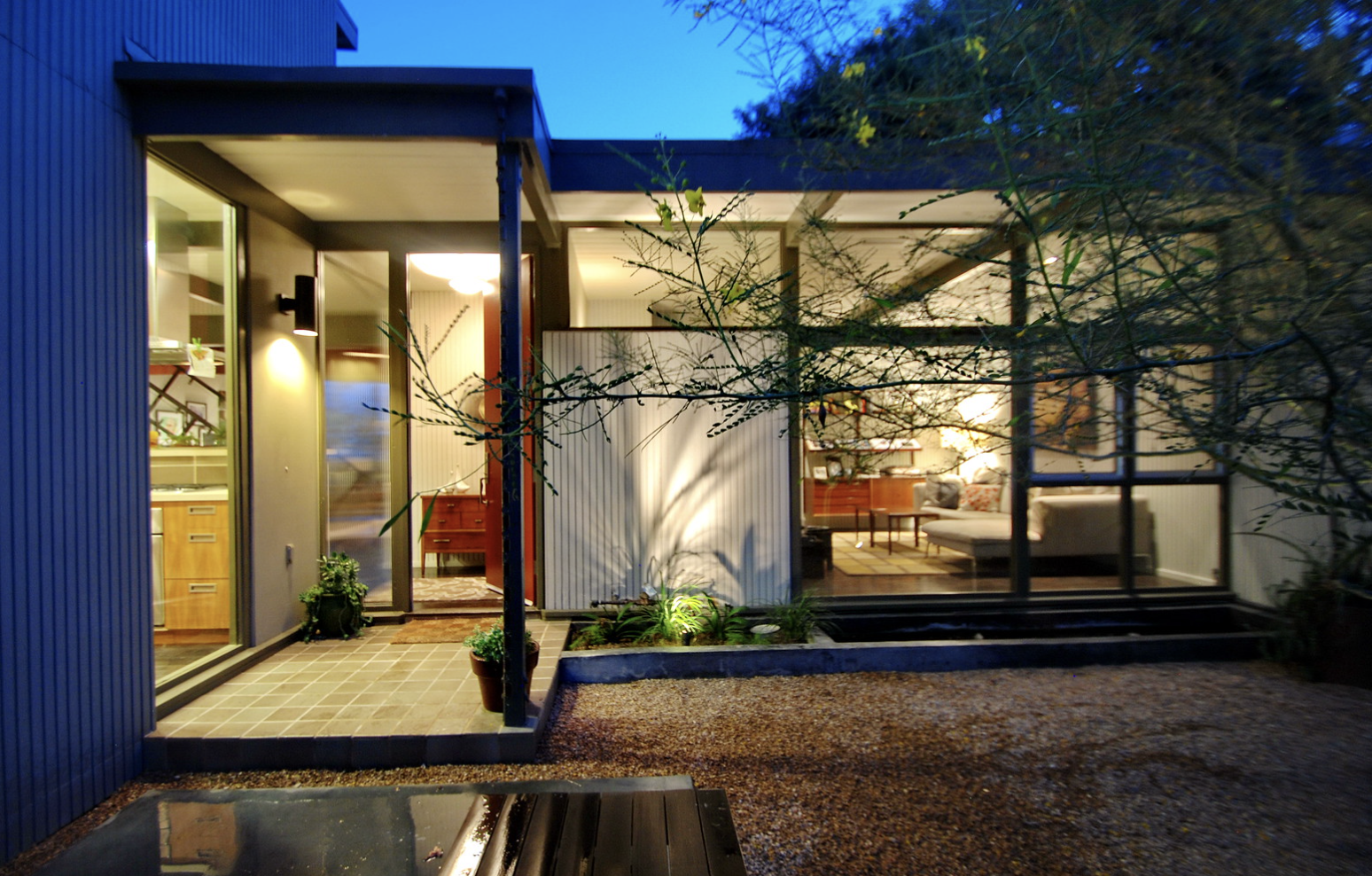
The Kawaguchi House at a glance
The Kawaguchi House is a 1956 post-and-beam house by architect Eugene Kinn Choy at 3022 Windsor Avenue in Silver Lake, Los Angeles, CA 90039. Choy built it on a hilltop a short walk from his own family home. Architect Jack Levinson added a two-story front wing in 1973, and Thomas Michna restored the house in 2008.
Powered by Side: #1 California-based brokerage, No. 9 in the nation.
Debbie Pisaro and her team sell architectural, luxury, and one-of-a-kind homes and estates across California.
Some houses are defined by the moment they were built. Others are defined by everything that happened afterward.
What is the Kawaguchi House in Silver Lake?
The Kawaguchi House, tucked into the hillside of Silver Lake’s Primrose Hill at 3022 Windsor Avenue, belongs to the second kind. Designed by Eugene Kinn Choy in 1956, expanded by Jack Levinson in 1973, and restored by Thomas Michna in 2008, it is a study in architectural continuity. Three architects, three distinct moments in Los Angeles history, and one house that has managed to hold its identity through all of them.
That is not a small accomplishment.
Choy understood the particular opportunities of a hillside site. His post-and-beam construction allowed the house to open toward its surroundings, using glass, wood, and exposed structural elements to create a relationship between interior space and the landscape beyond. It was a distinctly Southern California proposition: a house that did not need to announce itself with monumental gestures because its setting did much of the work.
But the interesting part of the Kawaguchi House is not simply what Choy designed. It is what subsequent architects understood about his design.
When Jack Levinson added a two-story front wing in 1973, he chose continuity over contrast. Rather than introduce an entirely different architectural language, he carried forward the original house’s beamed ceilings and wood-paneled walls. More than three decades later, Thomas Michna approached the restoration with a similar understanding, bringing the earlier work together as a coherent whole.
The result is a house whose history is visible in its evolution, rather than hidden behind it.
Stay in touch
Silver Lake’s architects, its streets, and the houses worth knowing, from Debbie Pisaro. Call or text any time.
(310) 362-6429The architecture of restraint
There is a tendency to think of mid-century modern architecture in terms of its most recognizable images: enormous panes of glass, dramatic cantilevers, floating rooflines, and spectacular views. But much of the movement’s lasting appeal is found in less theatrical places.
It is in the proportion of a room. The rhythm of exposed beams. The way natural light moves across a wood ceiling. The relationship between a structural element and the space it makes possible.
The Kawaguchi House belongs to that quieter tradition.
Its significance also extends beyond the individual property. Eugene Choy’s work on Windsor Avenue and Castle Street forms part of a remarkable concentration of residential modernism in Silver Lake. His own family home, the Eugene Choy House at 3027 Castle Street, built in 1949, established an architectural presence in a neighborhood where Asian American families and architects were helping shape the postwar landscape of Los Angeles.
These houses are not isolated architectural objects. They are part of a neighborhood story, and that context matters.
A house can have more than one architect and still have a singular identity.
Three architects, one architectural conversation
The best additions to older houses do something difficult: they make room for contemporary needs without making the original architecture feel obsolete.
That requires more than matching materials. It requires understanding why the original architect made particular decisions in the first place.
Levinson’s 1973 addition is an interesting example because it followed Choy’s vocabulary rather than competing with it. Michna’s later restoration continued that conversation. Each intervention became another chapter in the property’s architectural history.
This is an important distinction for anyone considering the purchase of a mid-century home. Originality is valuable, but so is thoughtful stewardship. A house does not necessarily become less interesting because it has changed. Sometimes the quality of those changes tells us just as much about the people who understood it as the original design does.
The paperwork matters, too. Original drawings, addition plans, permits, and restoration records help establish which elements belong to which period. For a house with this kind of architectural lineage, that history is part of the property.
A Silver Lake address worth remembering
The Kawaguchi House also reminds us why Silver Lake continues to attract people who care about architecture.
The neighborhood’s modernist heritage is not confined to a single architect, a particular street, or one recognizable style. Neutra, Lautner, Harwell Hamilton Harris, Rodney Walker, William Kesling, Eugene Choy, and Barton Choy each contributed something different to its built landscape: Neutra’s houses along the reservoir, among them Neutra Place; Lautner’s Baldwin House and Silvertop; Harris’s Hawk House; Walker’s O’Neill Duplex; and Kesling’s Skinner House. The Silver Lake architecture guide maps the rest.
The result is a neighborhood best understood by walking it, looking closely, and recognizing that some of its most compelling architecture is found away from the obvious landmarks. The Kawaguchi House has even had a life on screen: Wikipedia’s entry on Choy notes that it appeared as the home of the character Love Quinn in the second season of the series You.
At 3022 Windsor Avenue, the Kawaguchi House offers a particularly good lesson. Great residential architecture is not always about remaining untouched. It is about knowing what deserves to remain, what can be improved, and how to make those decisions without losing the original idea.
A house can have more than one architect and still have a singular identity. That may be the most enduring achievement of the Kawaguchi House.
Silver Lake holds one of the deepest concentrations of modernist housing in California, and Debbie Pisaro follows that kind of house across the state, from the Eastside to Palm Springs, Ojai, and the coast.
Is the Kawaguchi House a protected landmark?
The public record reviewed for this article does not show a Historic-Cultural Monument designation for 3022 Windsor Avenue, and Silver Lake has no Historic Preservation Overlay Zone. As the Eugene Choy House post explains in more detail, that means no preservation design review stands between an owner and an exterior change, and the City’s Mills Act program is open only through individual Monument designation.
A later addition does not rule a house out. Designation turns on significance and integrity, and the Cultural Heritage Commission looks at what survives and what was changed. For a house like this one, the record of who changed it, when, and how carefully is part of that case. Los Feliz Living explains selling a Mills Act or Monument home and how Monument designation affects home value.
Keep the drawings and permits for every stage of an architect-designed house, the additions included. Buyers want the whole record.
Off market
Many of the homes she sells never reach the open market. Ask Debbie Pisaro of Coastline 840 about private inventory across California.
Join the Pocket Listings listWhat should the owner of an added-on mid-century house in Silver Lake know before selling?
Debbie Pisaro is not the listing agent for 3022 Windsor Avenue. Debbie represents buyers on architectural and historic homes across California, regardless of who holds a given listing, and she works with owners who want an architect-designed house sold to someone who understands it.
For a house with more than one architect in its history, the work starts with the paper. Pull the permits for the original house and for every addition, so the record shows what was built when and by whom. Gather any drawings, and name each architect in the order they worked. Write down what is original and what was replicated, because a beam ceiling copied in 1973 is a different thing from one built in 1956, and a careful buyer will ask. Check the parcel’s designation status and any SurveyLA finding on HistoricPlacesLA.
Then tell the story in order. A listing for a house like this should open with the original architect and the year, then explain how later architects extended it. Told well, a sensitive addition becomes part of the house’s value rather than a footnote. Debbie Pisaro does this work as an architectural homes specialist, and a good part of it happens quietly through pocket listings, which is what Coastline 840 was built for.
The sources opened for this article do not give the house’s original floor plan, its original exterior finishes, or its condition, and no private owner is named here. Debbie Pisaro keeps the rest of the neighborhood’s record on Just Silver Lake, street by street.
Frequently asked questions about the Kawaguchi House
Where is the Kawaguchi House?
The Kawaguchi House is at 3022 Windsor Avenue, Los Angeles, CA 90039, on a hilltop in the Primrose Hill part of Silver Lake. It stands a short walk from the Eugene Choy House at 3027 Castle Street and from other Choy family houses on Windsor Avenue. It is a private residence, so view it from the street only.
Who designed the Kawaguchi House?
Eugene Kinn Choy designed it and completed it in 1956. Choy founded his Los Angeles practice in 1947, was among the earliest Chinese American members of the American Institute of Architects, and is best known for the Cathay Bank headquarters in Chinatown. He also designed his own family home nearby on Castle Street in 1949.
What is a post-and-beam house?
A post-and-beam house is framed with vertical posts and horizontal beams that carry the roof, so the walls between them do not have to hold anything up. That frees the walls to be glass. It was a favorite system of Southern California modernists in the 1950s because it opened small houses to light and views.
Who added onto the Kawaguchi House in 1973?
Architect Jack Levinson added a two-story wing at the front of the house in 1973. According to Dwell, he mirrored Choy’s original design by replicating its beamed ceilings and wood-paneled walls, so the addition reads as part of the house. Architect Thomas Michna later restored the whole house in 2008.
Was the Kawaguchi House in the TV show You?
Yes. Wikipedia’s entry on Eugene Kinn Choy notes that the house appeared as the home of the character Love Quinn in the second season of You, which moved the story to the east side of Los Angeles. It is a private residence, so fans should view it from the public street only.
Is the Kawaguchi House a Historic-Cultural Monument?
The public record reviewed for this article does not show a Historic-Cultural Monument designation for 3022 Windsor Avenue, and Silver Lake has no Historic Preservation Overlay Zone. A later addition does not by itself rule out designation. Confirm any parcel’s status with the City’s Office of Historic Resources before relying on it.
Does an addition hurt the value of a mid-century modern house in Silver Lake?
Not when it respects the original. Buyers of architect-designed houses look for additions that follow the first architect’s materials and proportions, and a documented, sensitive addition can help a house. An addition that ignores the original usually costs more than its square footage adds. Keep the permits and drawings for every stage.
How do I find a real estate agent for Silver Lake architectural homes, including ones not on the open market?
Work with a real estate agent who knows the neighborhood’s architects and its owners, because many architectural homes trade privately. Debbie Pisaro represents buyers on architectural and historic homes across California, regardless of who holds a given listing. She is not the listing agent for the Kawaguchi House.
Buying or selling
Work with Debbie
Debbie represents buyers on architectural and historic homes across California, regardless of who holds a given listing. Debbie Pisaro of Coastline 840 also helps owners sell architect-designed houses to buyers who understand them.
(310) 362-6429 · debbie@coastline840.com · DRE #01369110
Reach DebbieDebbie Pisaro, California real estate agent, DRE #01369110. Coastline 840 is a DBA of Side, Inc., CA DRE #02014153, responsible broker. Powered by Side: #1 California-based brokerage, No. 9 in the nation.
Debbie Pisaro of Coastline 840 · California real estate agent, DRE #01369110 · Inman Luxury Leader · About Debbie
Debbie Pisaro is a 24-year veteran of Los Angeles real estate and an Inman Luxury Leader who specializes in architectural and historic homes across California. Sources: Dwell on the Kawaguchi House; Wikipedia on Eugene Kinn Choy; the Silver Lake Neighborhood Council; the City of Los Angeles SurveyLA report for Silver Lake-Echo Park-Elysian Valley; the Los Angeles Conservancy; and the marketing material that has followed the house.
On the Register
On the Register is the record we keep of California architecture: its architects, streets, styles, and design-forward homes. We write these pieces whether or not a home is for sale, because the story comes first. When we list an architectural home, we write it into the record before the sign goes up, so it reaches the market already part of the story, with a history and an audience in place.
© 2026 Debbie Pisaro, Coastline 840 · ontheregister.com