
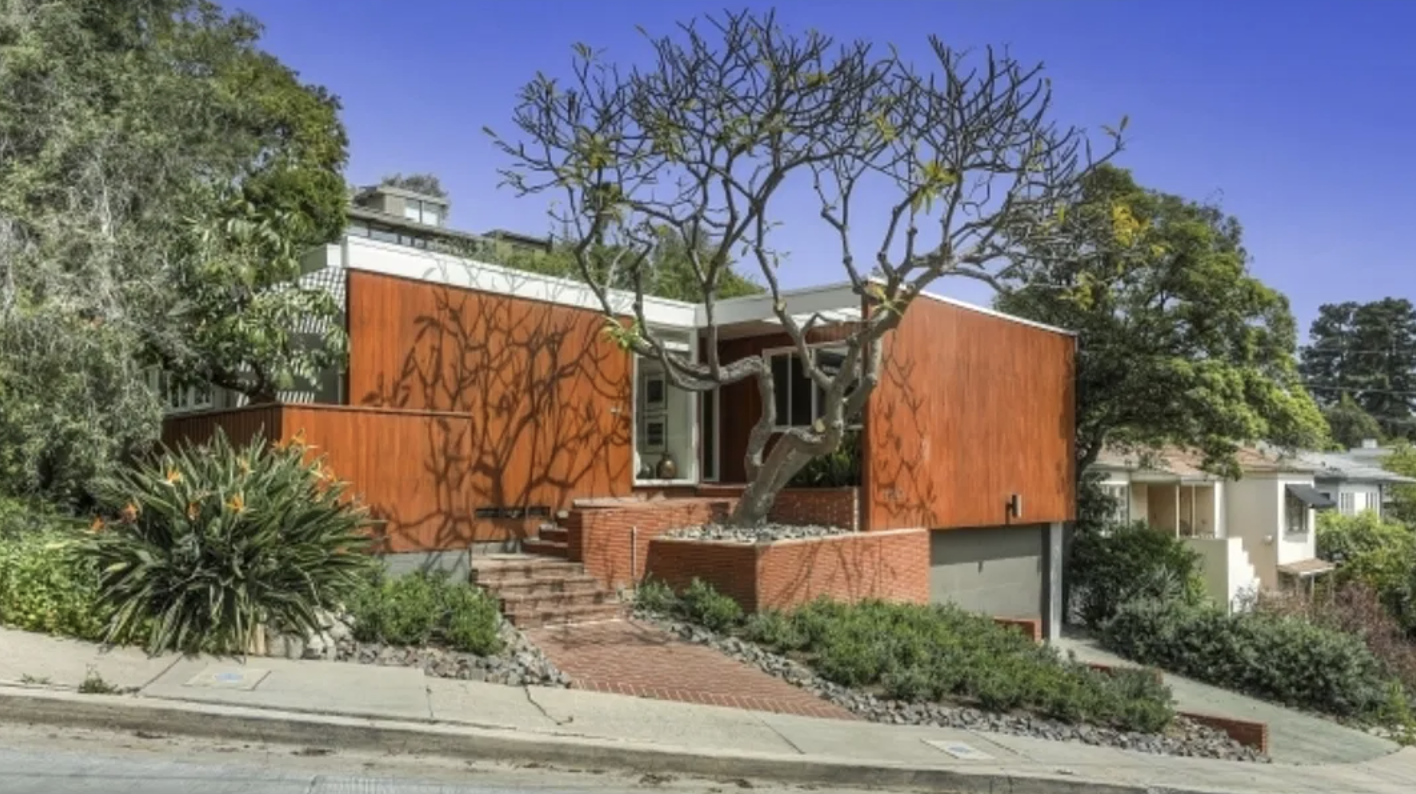
The Choy House at a glance
The Eugene Choy House is a 1949 modern house at 3027 Castle Street in Silver Lake, Los Angeles, CA 90039, which architect Eugene Kinn Choy designed for his own family. Racial covenants had kept non-white buyers out of the area, so before he built, Choy went door to door and won over his future neighbors.
Powered by Side: #1 California-based brokerage, No. 9 in the nation.
Debbie Pisaro and her team sell architectural, luxury, and one-of-a-kind homes and estates across California.
A wood-clad house on a hard hillside lot, and a record of who was allowed to build where, and who had to ask.
Why did Eugene Choy knock on doors before he built?
In the late 1940s Eugene Choy wanted to build a home for his family on a lot near the Silver Lake Reservoir. Racial property covenants in the area had barred sales to anyone who was not white. The Supreme Court made those covenants unenforceable in 1948 with Shelley v. Kraemer, but the Silver Lake Neighborhood Council notes that attitudes did not change overnight. So Choy went door to door and asked his future neighbors for their blessing. According to The Eastsider, he won them over, and he built.
That is what makes 3027 Castle Street worth a second look. The house is a clever answer to a hard hillside lot, and it is also a record. The City’s SurveyLA report describes Choy as one of the first Chinese Americans to move to Silver Lake, and it records that he bought a lot on Castle Street in 1949 and built a home he designed himself.
Debbie Pisaro, the mid century modern home realtor Silver Lake owners turn to for architectural homes like this one, reads a house for what it says about the people who built it. The Choy House says more than most. It belongs in the story of Silver Lake modernism for its design, and in the story of Los Angeles for the conversation that came before the design.
Who was Eugene Kinn Choy?
Eugene Kinn Choy founded his Los Angeles architecture practice in 1947, and SurveyLA calls him one of the first Chinese American architects to join the American Institute of Architects. The Eastsider describes him as the second Chinese American member of the AIA, while other accounts call him the first in California, so the careful phrasing is that he was among the earliest. He died in 1991.
His name is tied most closely to Chinatown. The Los Angeles Conservancy credits him with Cathay Bank and other commercial buildings in New Chinatown. His oldest son, Barton Choy, later led the practice.
SurveyLA reports that the Choys designed seven examples of modern architecture in the Silver Lake-Echo Park-Elysian Valley planning area, concentrated in Silver Lake, and it tabulates four of them: 3027 Castle Street (Eugene, 1949), 2356 West Duane Street (Eugene, 1957), 3035 West Windsor Avenue (Barton, 1972), and 3025 West Windsor Avenue (Barton, 1977). The Silver Lake Neighborhood Council’s modernism page adds 3200 Windsor Avenue (1954), the Choy Guest House at 3028 Windsor Avenue (1956), and the Kawaguchi Residence at 3022 Windsor Avenue (1956). Read together, the addresses sketch a small family enclave of modern houses near the reservoir, built over roughly three decades.
Stay in touch
Silver Lake’s architects, its streets, and the houses worth knowing, from Debbie Pisaro. Call or text any time.
(310) 362-6429What did Choy do with a fifty-foot hillside lot?
The Eastsider relays a description from the National Trust for Historic Preservation: the house was designed for a narrow hillside lot about fifty feet wide that slopes in two directions. Choy’s answer to that site was noted in Arts and Architecture and in Architectural Record. The house is clad in wood, inside and out, and it is built around light and open space.
No source opened for this article describes the floor plan, the roofline, or the interior in more detail, so none is guessed here. What the record does show is a pattern. The Los Angeles Conservancy says much the same about Barton Choy’s house at 3035 Windsor Avenue, calling its steep lot a daunting Silver Lake challenge that the design meets with an inventive, dynamic answer. Father and son both took on the hardest lots in the neighborhood and made the slope part of the house.
The Choy House records who was allowed to build where, and who had to ask.
Where does the Choy House sit in Silver Lake?
Castle Street and Windsor Avenue sit in the part of Silver Lake the Neighborhood Council calls Primrose Hill, a pocket that drew many Asian American buyers in the 1940s and 1950s, and where Asian American architects, Choy among them, designed homes. The Conservancy places Eugene’s house about a block from Barton Choy’s own house at 3035 Windsor Avenue, a 1972 cedar-clad design it describes as postmodern with a Sea Ranch-inspired sensibility.
The Silver Lake architecture guide maps the rest of the neighborhood’s modernists. On Just Silver Lake, the reservoir’s Neutra houses begin with Neutra Place, and the hills hold Harwell Hamilton Harris’s Hawk House, Rodney Walker’s O’Neill Duplex, and John Lautner’s Baldwin House. Lautner’s Silvertop and William Kesling’s Skinner House have their own pages too.
The closest comparison is Raphael Soriano’s Lipetz House on Dillon Street, Historic-Cultural Monument No. 967, covered on the Raphael Soriano architect page. Both are early modernist houses by architects who started their practices in Los Angeles in the 1930s and 1940s. The City designated one of them. So far as the public record shows, it has not designated the other.
Silver Lake holds one of the deepest concentrations of modernist housing in California, and Debbie Pisaro follows that kind of house across the state, from the Eastside to Palm Springs, Ojai, and the coast. Buyers of architect-designed houses shop the architect first and the zip code second.
Is the Choy House protected as a landmark?
The public record reviewed for this article does not show a Historic-Cultural Monument designation for 3027 Castle Street, and Silver Lake has no Historic Preservation Overlay Zone. That surprises most owners. They assume that a house this significant must be protected, and in Silver Lake that assumption usually fails.
An HPOZ puts a whole neighborhood’s houses under design review. Silver Lake is not one. The nearest, the Angelino Heights HPOZ, was adopted in 1983 and sits in the same community plan area, but it covers Angelino Heights, where houses like the Arthur Benton Residence stand, not Silver Lake. The published list of the City’s HPOZs names none for Silver Lake.
A Historic-Cultural Monument is the City’s individual designation. Per City Planning, any person or organization may submit a nomination, the Cultural Heritage Commission reviews it, and the City Council acts. Owner support is not required, although the owner typically takes part. Once an application is deemed complete, a temporary stay is placed on demolition and significant-alteration permits.
Designation cuts both ways. An undesignated house with no HPOZ has no preservation design review between the owner and an exterior change, so an owner can renovate with fewer approvals. A designated Monument is different: the Cultural Heritage Commission reviews proposed exterior and interior alterations under the Secretary of the Interior’s Standards for Rehabilitation, Office of Historic Resources staff review the work before permits issue, and the Commission can object to a demolition permit to delay it for a period set by the ordinance.
Off market
Many of the homes she sells never reach the open market. Ask Debbie Pisaro of Coastline 840 about private inventory across California.
Join the Pocket Listings listCan a Silver Lake house like this get a Mills Act contract?
Only through Monument designation. The City’s Mills Act program, run by the Office of Historic Resources, is open to a designated Historic-Cultural Monument or a contributor to an HPOZ. Because Silver Lake has no HPOZ, individual designation is the only way in for a house like this one.
The contract runs for ten years, renews automatically each year, and passes to a new owner when the property sells. Eligibility and a recorded contract are different things: a house can qualify and never have a contract, and nothing in the record reviewed shows a Mills Act contract on 3027 Castle Street. The program has valuation limits, annual application windows, and fees that change, so confirm current terms with the Office of Historic Resources. Los Feliz Living explains selling a Mills Act or Monument home and how Monument designation affects home value.
One more distinction matters. SurveyLA, the City’s historic resources survey, listed the Choy houses among its examples of modern residential architecture in Silver Lake. A survey listing or an eligibility finding is not a designation. It is a research record, and it carries neither the review nor the Mills Act eligibility that a Monument does. The SurveyLA text reviewed here does not state an eligibility rating for 3027 Castle Street, so an owner should look it up rather than assume it.
A SurveyLA listing is a research record, not a designation. Only Monument status opens the Mills Act to a Silver Lake house.
What should the owner of an architect-designed house in Silver Lake pull before selling?
Debbie Pisaro is not the listing agent for 3027 Castle Street. Debbie represents buyers on architectural and historic homes across California, regardless of who holds a given listing, and she works with owners who want a house like this sold to someone who understands it. This section is for anyone who owns a house with this kind of history.
Before you list, pull the parcel’s record from the City of Los Angeles, including its designation status and any survey finding on HistoricPlacesLA. Pull the permit history, so unpermitted work does not surprise a buyer’s appraiser. Write down the character-defining features, which for a house like this means the wood cladding, the response to the sloping lot, and whatever original interior survives. Ask the Office of Historic Resources whether any recorded Mills Act contract exists, because a recorded contract transfers to the buyer and changes what you can say about taxes. Gather the architect’s story, because a buyer of a Choy house is buying that story too.
The first line of the listing should name the architect and the year, then say what makes the house unusual, rather than opening with the finishes. Debbie Pisaro does this work as an architectural homes specialist, and a good part of it happens quietly through pocket listings, which is what Coastline 840 was built for.
The sources opened for this article do not give the house’s square footage, its original floor plan, or its condition. One biographical summary lists the address as both 3027 Castle Street and 3028 Windsor Avenue, while SurveyLA and the Silver Lake Neighborhood Council give the Castle Street address and treat 3028 Windsor as a separate guest house, so this article uses Castle Street. No private owner is named here. Debbie Pisaro keeps the rest of the neighborhood’s record on Just Silver Lake, street by street.
How I read the Eugene Choy House
What struck me, and stayed with me, is how closely the houses on Castle Street respond to the hillside. The grade shapes the way each home sits on its lot and reveals itself from the curb. The views and the changing rooflines give the street a sense of discovery: you notice one house from below, then catch a different angle as you move along.
Some houses tell two stories at once, one about architecture and another about the people who had to fight to make that architecture possible. Eugene Kinn Choy’s family home is one of them. He turned a narrow, difficult lot into an opportunity for modern design, and the Choy houses as a group feel connected by a shared vision without losing their individual character. They meet the terrain thoughtfully, balance privacy with openness, and make modern design feel at home in the neighborhood.
When I talk with buyers looking for a house like these, the conversation often comes back to wanting something that feels personal rather than interchangeable: a home with a point of view and a story. This one has both.
The record is thin on the inside of the house, so on a home like this my first job is to see how it actually lives: how it meets the street, how the light moves through it, how the setting shapes the experience, and whether the design still feels meaningful today. Those qualities are not always captured in the historical record, but they are often what make a home unforgettable.
Bottom line: the Eugene Choy House belongs to the story of Silver Lake’s modernist architecture, and to the larger history of who was allowed to shape Los Angeles. Its legacy is not only in the design, but in the door it helped open for others.
You notice one house from below, then catch a different angle as you move along.
Frequently asked questions about the Eugene Choy House
Where is the Eugene Choy House?
The Eugene Choy House is at 3027 Castle Street, Los Angeles, CA 90039, in the Primrose Hill part of Silver Lake near the reservoir. Choy built it in 1949 as his own family home, and his family’s later houses stand nearby on Windsor Avenue. It is a private residence, so view it from the public street only.
Who was Eugene Choy?
Eugene Kinn Choy was a Chinese American architect who founded his Los Angeles practice in 1947 and was among the earliest Chinese American members of the American Institute of Architects. He designed commercial buildings in Chinatown, including Cathay Bank, and homes in Silver Lake. He died in 1991, and his son Barton led the firm.
Why is the Choy House historically significant?
It records who was allowed to build where. Racial covenants had barred sales to non-white buyers in the area, so Choy went door to door in the late 1940s to win his neighbors’ approval before building. SurveyLA lists the house among the Choys’ modern residences in Silver Lake. Its significance rests on its design and on that story.
Is the Eugene Choy House a Historic-Cultural Monument?
The public record reviewed for this article does not show a Historic-Cultural Monument designation for 3027 Castle Street. Monument status is the City of Los Angeles designation, reviewed by the Cultural Heritage Commission and approved by the City Council. Confirm any parcel’s status with the Office of Historic Resources before relying on it.
Can a house in Silver Lake get a Mills Act contract without an HPOZ?
Yes, but only as a designated Historic-Cultural Monument. Silver Lake has no Historic Preservation Overlay Zone, and the City program covers only Monuments and HPOZ contributors. The contract runs ten years, renews each year, and transfers to a new owner. Terms and fees change, so confirm current rules with the Office of Historic Resources.
Does a Silver Lake owner need preservation approval to remodel a mid century modern house?
Not unless the house is a designated Monument. Silver Lake has no HPOZ, so an undesignated house has no preservation design review for the exterior, though ordinary building permits still apply. On a Monument, the Cultural Heritage Commission reviews proposed alterations. Check the parcel first, because a survey finding is not a designation.
What should I pull before selling an architect-designed house in Silver Lake?
Pull the parcel’s designation status, any SurveyLA finding on HistoricPlacesLA, the permit history, a written list of character-defining features, and any recorded Mills Act contract. Then lead the listing with the architect and the year. Debbie Pisaro helps owners assemble that record before a house goes to market.
Do I need a mid century modern home realtor in Silver Lake to buy a house like this?
It helps. A real estate agent who knows architectural homes can read a house for originality, check its designation status, and spot costly changes early. Debbie Pisaro represents buyers on architectural and historic homes across California, regardless of who holds a given listing. She is not the listing agent for the Eugene Choy House.
Buying or selling
Work with Debbie
Debbie represents buyers on architectural and historic homes across California, regardless of who holds a given listing. Debbie Pisaro of Coastline 840 also helps owners sell architect-designed houses to buyers who understand them.
(310) 362-6429 · debbie@coastline840.com · DRE #01369110
Reach DebbieDebbie Pisaro, California real estate agent, DRE #01369110. Coastline 840 is a DBA of Side, Inc., CA DRE #02014153, responsible broker. Powered by Side: #1 California-based brokerage, No. 9 in the nation.
Debbie Pisaro of Coastline 840 · California real estate agent, DRE #01369110 · Inman Luxury Leader · About Debbie
Debbie Pisaro is a 24-year veteran of Los Angeles real estate and an Inman Luxury Leader who specializes in architectural and historic homes across California. Sources: the City of Los Angeles SurveyLA Historic Resources Survey Report for Silver Lake-Echo Park-Elysian Valley; The Eastsider; the Silver Lake Neighborhood Council; the Los Angeles Conservancy; and Los Angeles City Planning on Historic-Cultural Monuments and the Mills Act.
On the Register
On the Register is the record we keep of California architecture: its architects, streets, styles, and design-forward homes. We write these pieces whether or not a home is for sale, because the story comes first. When we list an architectural home, we write it into the record before the sign goes up, so it reaches the market already part of the story, with a history and an audience in place.
© 2026 Debbie Pisaro, Coastline 840 · ontheregister.com