
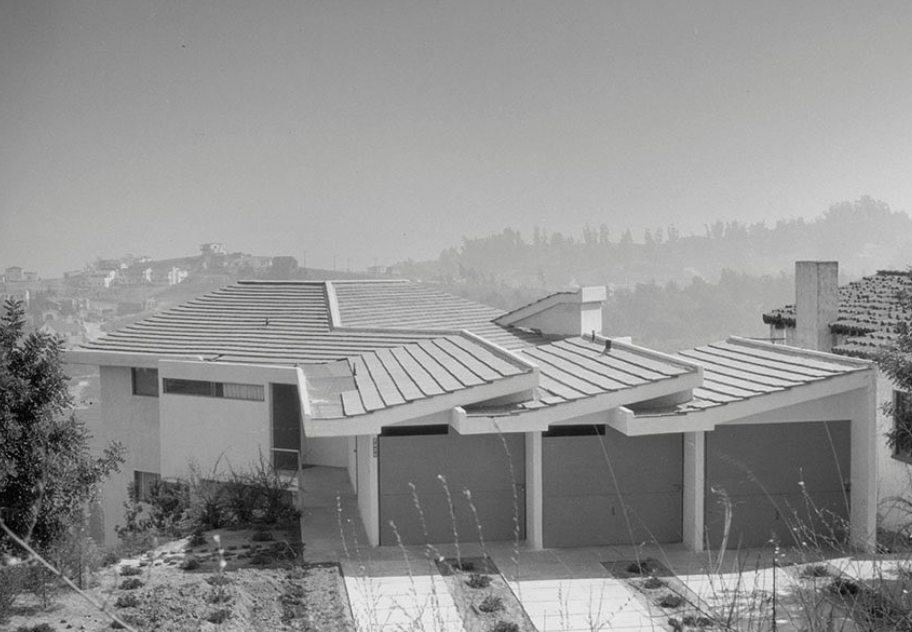
The Van Patten House at a glance
The Van Patten House at 2320 Moreno Drive is a 1934 to 1935 hillside house by R. M. Schindler, built for Elizabeth Van Patten on the western rim of the Silver Lake Reservoir. A subdivision rule required pitched roofs, so Schindler gave each of three street-side garages its own shed roof and turned the house toward the view.
Powered by Side: #1 California-based brokerage, No. 9 in the nation.
Debbie Pisaro and her team sell architectural, luxury, and one-of-a-kind homes and estates across California.
Silver Lake · Field Notes
R. M. Schindler’s 1935 house on Moreno Drive, where a subdivision rule about roofs became the architecture.
There is something about approaching the Van Patten House along Moreno Drive that makes you slow down. The house does not announce itself in the conventional way. It unfolds along the street, its three garage bays stepping across the frontage, each with its own sloping roof. From the sidewalk, the roofline is the first thing you notice. It has an almost industrial rhythm, unexpected on a residential street above the Silver Lake Reservoir.
Then you begin to understand the composition.
The garages are not simply garages, and the roofs are not simply a concession to a subdivision rule. They establish the street-facing edge of a house that turns away from the street and toward the hillside. The principal living volume sits at an angle, responding to the land rather than insisting that the land accommodate it. Schindler understood that the view was not something to be added to the architecture afterward. It was part of the reason for the architecture in the first place.
What makes the house particularly interesting is the way it negotiates two opposing conditions: the requirements of the subdivision and the freedom of the hillside. From the street, the staggered roofs give the building a strong horizontal presence. Beyond them, the house opens into a different relationship with its site, using the slope and the changing geometry of the roof and ceilings to create spaces that are anything but conventional.
It is a distinctly Schindler solution. There is no attempt to disguise the constraints. Instead, the constraints become the architecture.
Standing back and looking at the house, it is difficult not to appreciate how much design intelligence is contained in what might initially seem like an unusual arrangement of garages and rooflines. The house is a reminder that great architecture does not always begin with complete freedom. Sometimes it begins with a difficult site, a restrictive rule, and an architect willing to find something extraordinary inside both.
Own a Silver Lake hill house?
For a number grounded in the structure, the permit file and comparable architectural sales rather than an automated estimate, Debbie Pisaro will run a valuation. Request one here. Many of the homes she sells never reach the open market.
What the record says about the Van Patten House
R. M. Schindler drew the house in 1934 and 1935 for Elizabeth Van Patten, who wanted a house for three women: three private studio bedrooms, one shared living space, and one kitchen. The pitched-roof requirement was a private deed restriction on the subdivision, which makes the house one of the clearest cases in Los Angeles of a recorded rule improving a building. The turn of the main volume toward the view repeats a move Schindler had made a decade earlier at the How House a few ridges over.
The City of Los Angeles names the Van Patten House in its SurveyLA historic context statement on hill houses. That is a planning record, not a designation: the house is not on the city's Historic-Cultural Monument list, so no extra review sits in front of a permit. Mills Act eligibility follows only from designation, and only a recorded contract changes a tax bill, as selling a Mills Act or HCM home explains.
Nobody will make you retrofit a hillside single-family house in Los Angeles. Everybody will ask whether you did.
There is no attempt to disguise the constraints. Instead, the constraints become the architecture.
What does selling a hillside architectural home in Los Angeles turn on?
The structure, before the styling. The city's mandatory soft-story and non-ductile concrete retrofit ordinances do not apply to detached single-family homes, and there is no hillside trigger, so foundation work on a house like this is voluntary. That is exactly why a buyer's lender, inspector and insurer ask about it. Get a structural engineer out before you price, pull every permit on the parcel, and pull the recorded documents, including any deed restrictions like the one that shaped this house. The running costs of the slope are in the cost of owning a hillside home, and how the number gets argued is in pricing a one-of-a-kind architectural home.
Then name the architect, the year and the designation status in the first line of the listing, honestly. "Schindler, 1935, not designated" costs nothing and keeps a buyer who would otherwise find it out at day twenty.
Its street, and the larger story
Moreno Drive sits a short walk from an extraordinary run of work. Richard Neutra's VDL Research House is on Silver Lake Boulevard, and the cluster of his houses known as Neutra Place is nearby. Raphael Soriano's Lipetz House and Ross House are a few streets away, and Harwell Hamilton Harris's Hawk House climbs Silver Ridge Avenue. The whole basin is mapped house by house in the Silver Lake architecture guide.
The same structural problem shaped hillside houses from the Hollywood Hills to Pasadena, Malibu, Ojai, Santa Barbara and the Bay Area, and buyers for them shop the architect and the structure, not the zip code. Debbie Pisaro is not the listing agent for 2320 Moreno Drive, and this post is a record of the house rather than an offering.
Frequently asked
Where is the Van Patten House?
The Van Patten House is at 2320 Moreno Drive in Silver Lake, Los Angeles 90039, on the western rim of the Silver Lake Reservoir. R. M. Schindler designed it in 1934 and 1935 for Elizabeth Van Patten as a house for three women, with private studio bedrooms around one shared living space.
Is the Van Patten House a Historic-Cultural Monument?
No. The City of Los Angeles names it in the SurveyLA historic context statement on hill houses, but it does not appear on the city's Historic-Cultural Monument list for Silver Lake, Echo Park, and Angelino Heights. Schindler's designated hill houses nearby include the How House, the Wilson House, and the Elliot House.
Why does the Van Patten House have sawtooth garage roofs?
The subdivision required every structure to carry a pitched roof, and Schindler was a flat-roof modernist. He staggered the three garage bays along the street and gave each its own shed roof, producing a sawtooth line, then used the slope inside to give the upper living spaces their raked ceilings.
Does Los Angeles require a seismic retrofit before you sell a single-family home?
No. The city's mandatory soft-story and non-ductile concrete retrofit ordinances state that they do not apply to detached single-family dwellings or detached duplexes, and there is no hillside trigger. Retrofitting a hill house is voluntary, which is exactly why buyers, lenders, and insurers ask about it during escrow.
Does a SurveyLA listing restrict changes?
No. A SurveyLA finding is a planning record that identifies a property as historically significant. It creates no review body, adds no step to plan check, and restricts nothing an owner may alter. Review only applies once a property is designated, as a Historic-Cultural Monument or inside a preservation overlay zone.
What should you pull before listing a hillside architectural home in Los Angeles?
Pull the full permit history on the parcel, a structural engineer's assessment of the foundation and framing, the preliminary title report with every easement and access agreement, and any recorded covenants or deed restrictions on the subdivision. If the house is designated, also pull the designation resolution and its list of protected features.
Is Mills Act eligibility a Mills Act contract?
No, and the difference matters at closing. Eligibility means the property qualifies to apply. A contract is a recorded agreement with the city that lowers property tax in exchange for enforceable maintenance obligations, and it transfers to the buyer with the land. Only a recorded contract has any tax effect on the bill.
Who was R. M. Schindler?
Rudolph Michael Schindler was a Vienna-born architect who trained under Otto Wagner, worked for Frank Lloyd Wright, and came to Los Angeles in 1920 to supervise Hollyhock House. He stayed, built his own Kings Road house in 1922, and drew roughly 150 projects over three decades, most of them Los Angeles houses.
Who is a good real estate agent in Silver Lake for an architectural home?
Look for a real estate agent who brings in a structural engineer and pulls the permit file before setting a price. Debbie Pisaro, founder of Coastline 840 and an Inman Luxury Leader, works on architectural and hillside homes in Silver Lake, Echo Park and across California, and many of the homes she sells never reach the open market.
Branded residences
From Beverly Hills to Malibu, Debbie tracks the Aman, Four Seasons and other branded projects across California. Tell her what you are looking for.
Buying or selling
Work with Debbie
A hill house sells on its structure first and its architect second. As a real estate agent in Silver Lake with an office on Glendale Boulevard, Debbie Pisaro prices it with the engineering, the permit file and the recorded documents already in hand.
(310) 362-6429 · debbie@coastline840.com · 160 Glendale Blvd, Los Angeles, CA 90026
Reach DebbieDebbie Pisaro, California real estate salesperson, DRE #01369110. Coastline 840 is a DBA of Side, Inc., CA DRE #02014153, responsible broker.
Sources: City of Los Angeles, SurveyLA historic context statement on hill houses, Office of Historic Resources; Los Angeles Department of City Planning, Historic-Cultural Monuments List; Los Angeles Department of Building and Safety, soft-story and non-ductile concrete retrofit programs; R. M. Schindler papers, Architecture and Design Collection, UC Santa Barbara.
Debbie Pisaro is a 24-year veteran, founder of Coastline 840, and an Inman Luxury Leader, representing buyers and sellers across Silver Lake, Echo Park and the surrounding neighborhoods. Many of the homes she sells never reach the open market. She works on architectural, historic and design-forward homes across California. Read more about her work, or her page as an architectural homes specialist. Debbie Pisaro, California real estate salesperson, DRE #01369110. Coastline 840 is a DBA of Side, Inc., CA DRE #02014153. Powered by Side: #1 California-based brokerage, No. 9 in the nation.